
Latest News
Clinical Care, Patient Stories
A Journey of Unrelenting Hope, Part II
Jan 26, 2026
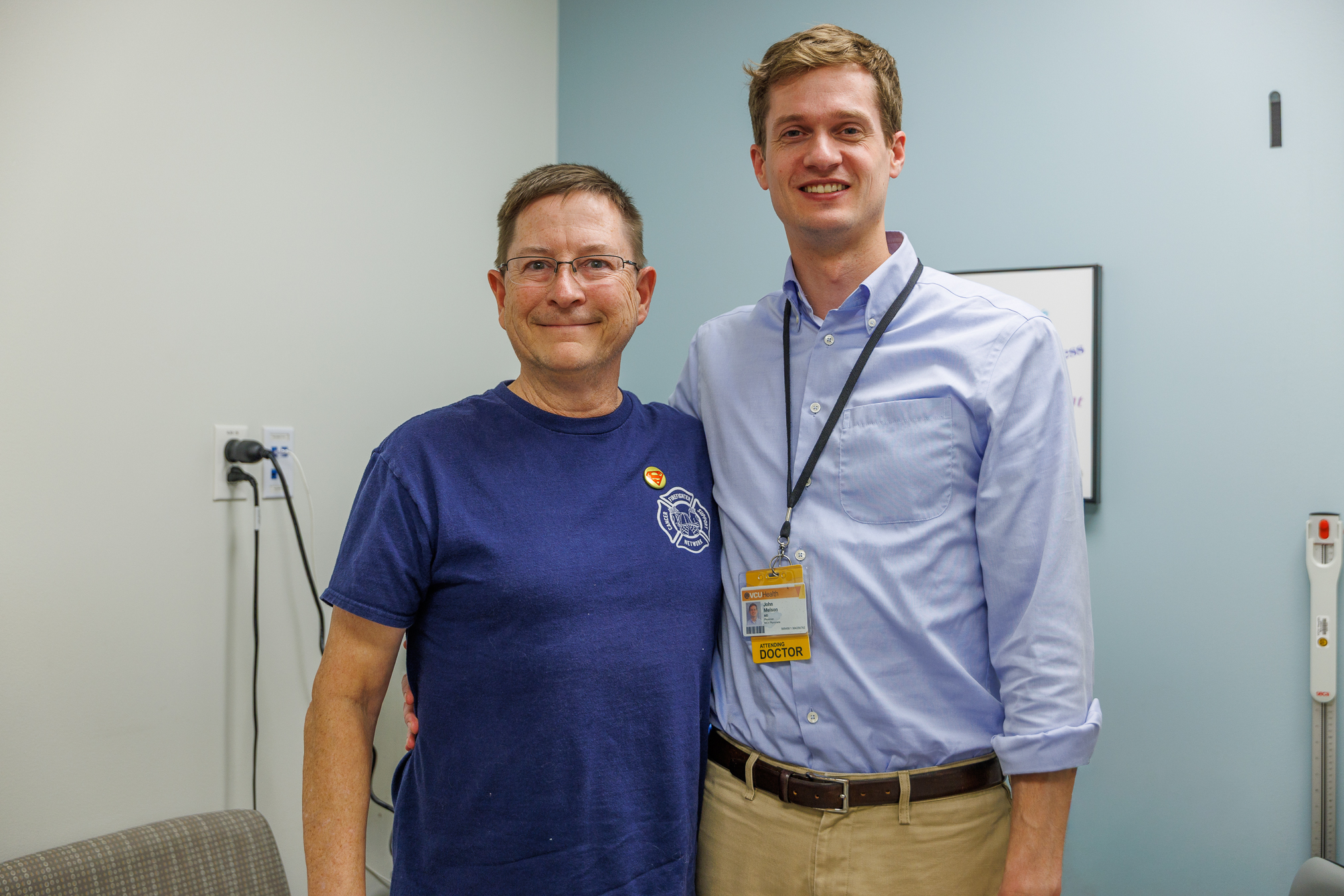 Pictured: Greg Leitz (left) and Dr. Jack Melson (right)
Two years ago, Greg Leitz’s world was spinning. It was on January 4, 2024, when he learned he had Gleason 9 prostate cancer.
Gleason 9 prostate cancer is an aggressive form of prostate cancer, and in Greg’s case, evidence on his scans showed that his cancer had also metastasized into several other sites, including his spine.
As a retired Spotsylvania County firefighter, Greg knew that over the last decade, cancer has become the leading cause of death for firefighters across the country.
“Fire departments are taking a lot of initiatives to try to mitigate those [cancer risks], but it's still an inherently dangerous occupation. So, you hear all of the bad stories that go with that, and it’s in the back of your head that this is the leading cause of death for firefighters. And now I have that. And not only that, it's metastatic.”
Due to Massey’s relationship with the Firefighter Cancer Support Network, Greg’s oncologist in Fredericksburg recommended he make the trip south on I-95 to meet with doctors at VCU Massey Comprehensive Cancer Center for a second opinion regarding his diagnosis.
At Massey, Greg’s case was initially taken up by Jack Melson, M.D., a medical oncologist who specializes in the treatment of prostate cancer. To Melson, Massey’s cancer service line helps streamline a patient’s care plan.
“Cancer care is inherently complicated. There are lots of different specialists involved in the care, and lots of logistics involved with imaging, blood tests. The cancer service line structure here allows for that multifaceted care to be streamlined.
“So, when someone comes here for their treatment, those different teams are in communication with each other, working with each other, allowing for a patient-oriented approach to bring all of those different pieces together.”
Comprehensive cancer care that goes beyond
That streamlined approach extends beyond Greg’s direct cancer care.
While undergoing cancer treatment, Greg was able to stay at the Doorways, which provides housing options for patients who would otherwise have to travel long distances for their treatment. With Greg living 70 miles from Massey and needing six straight weeks of treatment, the Doorways was a godsend.
“It was incredible,” Greg said. “The staff at the Doorways were very kind. The best part about the Doorways to me was the coffee pot. I'm a coffee drinker. Every morning I went down and got a cup of coffee, and it seemed like I would meet different people at the coffee pot.
“We would wind up talking about where we were [in our treatment] or they were going through something. We were able to comfort each other and lift each other up in prayer. I was able to walk every morning to my radiation appointments - a nice little seven or eight block walk - and get some fresh air and clear my head, which was incredibly helpful.”
Mental health care while facing cancer
While Massey helped provide both the life-saving cancer treatments and temporary lodging, Greg also took advantage of the chaplaincy program to strengthen his mental well-being.
A chaplain in the Spotsylvania County Fire Department, Greg initially tried to put on a brave face to his friends and family while undergoing his cancer treatment, telling everyone he was okay, while feeling increasingly isolated in his journey.
“I had a lot of anxiety built up within me, and things just kind of came to a head. So I decided to reach out.
“I called Massey to try to get in touch with [Chaplain] Charles, and then I couldn’t find him on my chart,” Greg recalled. “So, I called and the nice lady that answered the phone, she's just so joyous. And she said, ‘I'll reach out to him.’ And by the time I turned to walk back in the building, my phone was ringing, and it was Charles.”
Reverend Charles Riffee, M.Div., joined Massey in October 2021, supporting the spiritual and emotional needs of patients and families that arise during their cancer journey.
For “Chaplain Charles,” as he is affectionately known, he was able to establish a quick connection with Greg due to his having been a volunteer chaplain with the Louisa County Sheriff's Office prior to joining Massey.
“We talked for an hour and a half,” Riffee recalled about their initial conversation. “We had shared experiences, even though they were different. From a chaplaincy standpoint, I think that Greg knew that I was being authentic. When I say, ‘I want to make time,’ I'm going to make time because emotions can be very hard for people going through a difficult time.”
For Greg, being able to open up about the wide-range of emotions he was experiencing was liberating. “I hid it so well from my friends and family. Some of my best friends teared up when I told them about what I was going through. But Charles has just been incredible.”
Some of those conversations have been about Greg’s ability to be an advocate and example for others facing a cancer fight.
“We've been able to talk during those times about how this experience, as hard as it's been, can now inform how he wishes to care for people moving forward,” Riffee says. “And Greg's doing that. And it's a beautiful thing.”
One of Greg’s keys for anyone facing a cancer diagnosis is to lean into one’s available support networks: “My advice to cancer patients is to reach out early. Early detection and early talking about it. And support networks are huge. The number one thing I say to people is to get in a support group or reach out to the chaplaincy or somebody that you can talk to about all of this.”
Screening and support networks in action
January is Fire Fighter Cancer Awareness Month, and Greg is an advocate for screening after his own mandatory screening helped flag his initial cancer diagnosis.
“It's not pleasant. There's no doubt about it, but if it’s 20 seconds of unpleasantry, those could potentially add years to your life,” Greg advocated. “And you got to do it every year. That's just the way it is. I had to go, and I'm glad I did. And not every man has a job that says, ‘Okay, every year you're going to have a prostate screening [like firefighters do].’”
Occupational cancer claims more firefighters’ lives than any other cause – surpassing fires and other on-scene incidents. The Firefighter Cancer Support Network partnered with Massey to develop the Virginia Firefighters for Lifelong Health (VA-FLH), a registry that brings together academic researchers and the Virginia Fire Service Advisors to collaboratively develop research aims, study design, and timelines to inform research that will have a positive, direct, and timely impact on preventing cancer among Virginia’s firefighters.
“We know that work-related exposure as a firefighter is associated with increased risk of prostate cancer and several other cancers, as well,” Melson noted. “So for any one person, determining what type of screening to get and when to start screening really comes down to figuring out what your risk is and how to be proactive in managing that risk.
“There's good evidence from the World Health Organization that there’s a link between working as a firefighter and having an increased risk of developing one of several different types of cancer.”
One of the mottos of the Firefighter Cancer Support Network is “no one fights alone,” a phrase Greg used when he decided to lean on Chaplain Charles, his family, and his friends during the journey of the last two years.
One of the tangible signs of those support networks is the Superman pin Greg wears during all of his appointments at Massey. On his first day of radiation treatments, Greg was accompanied by his friend and fellow firefighter Matthew Embrey. While Embrey was in the waiting room, he met a patient who was also there for a radiation treatment. That patient gave Embrey a Superman pin, which he then passed along to Greg. Greg has kept the pin ever since, despite never meeting the man who distributed it.
“As I continued my radiation treatments, I noticed that there were some folks that were also wearing the same pins. I have no idea what that gentleman’s name is, or what his outcome has been, but the Superman pin I wear for him because he gave that to me,” Leitz said. “I just thought that was really, really cool. And I bet if you go over to radiation oncology, you might see some of the techs that have been there for a couple of years wearing them, too.”
Two years on
Two years from his initial diagnosis, Greg continues his relationship with Chaplain Charles, talking to him at least twice a month. He also returns to Richmond every three months to meet with Dr. Melson.
“Greg has done a great job with treatment, and right now, we have great control of the cancer,” Melson says. “And I think Greg has a lot of life ahead of him. He will at some point, we expect, have the cancer reappear, and we will need to adjust the treatment plan. And when that day gets here, we'll make that change.
“I talk about this with Greg a lot - there's always a balance between the efficacy of our treatments and maintaining quality of life for a patient, and not allowing the cancer treatment to compromise that quality of life. And right now, I think we're in a very good spot with Greg where we've found that balance.”
For Greg, that balance means a return to the things he loves - firefighting, enjoying the outdoors and making time with his family.
“I work three days a week at the fire department. I'm a life member there as well, so I run an occasional fire call, which is kind of fun. As far as crawling down the dark hallway and the house fire right now, I’m not doing that yet, but if things continue to improve like they are - maybe about a year from now - I'll be crawling down the dark hallway again.
“My wife and I walk a lot. Right across the street from us is one of the National Park Service properties that has very well-maintained trails. So, I do at least two or three miles walking a day, and then I typically try to have a 10-mile day once a week. We're 45 minutes from Shenandoah, so I spend a lot of time up there. We just got back from Yosemite, where I did a ton of hiking out there.”
Uncommon comprehensive cancer care
To Greg, who lives 70 miles from Richmond, Massey’s ability to recreate the feel of a small town is a differentiator after having experienced care at several providers.
“Everybody at Massey is so friendly and nice. I've been around a bunch of other health care systems, and you just don't seem to get that in other places. I have never had a bad experience at Massey.
“You walk down the hall, everybody is saying ‘hi’ to you, or ‘good morning’ and they’re truly caring. For a big city urban hospital, to have that level of compassion and caring is uncommon.”
Written by: Bill Potter
Related News
Research & Innovation, Clinical Care, Community Engagement
Leaps and bounds in radiation oncology: Putting patients at the center of their cancer careMar 10, 2026
Research & Innovation, Clinical Care, Community Engagement
Clinical trials: Shaping the standard of cancer care for the countryFeb 9, 2026

Get access to new, innovative care
Treatments in clinical trials may be more effective or have fewer side effects than the treatments that are currently available. With more than 200 studies for multiple types of cancers and cancer prevention, Massey supports a wide array of clinical trials.
Find a provider
Massey supports hundreds of top cancer specialists serving the needs of our patients. Massey’s medical team provides a wealth of expertise in cancer diagnosis, treatment, prevention and symptom management.