Latest News
Research & Innovation, Clinical Care, Prevention
Colorectal Cancer Awareness Month: Q&A with Dr. Khalid Matin
Mar 18, 2026
March is Colorectal Cancer Awareness Month, and according to the American Cancer Society, colorectal cancer is the third-most commonly diagnosed form of cancer in the United States, excluding skin cancers. Colorectal cancer is the second leading cause of cancer-related deaths in the U.S and the leading cause of cancer-related deaths in people below the age of 50.
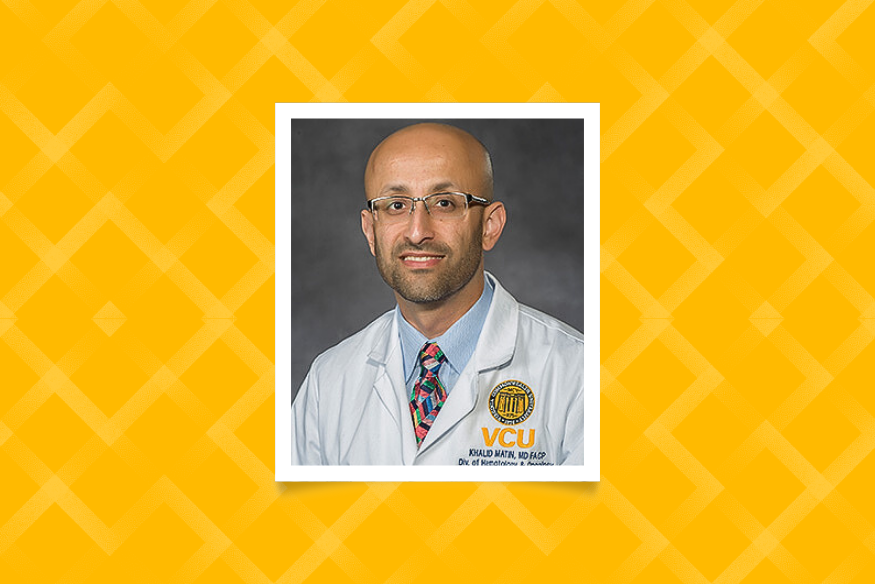
In 2026, over 155,000 cases of colorectal cancer will be diagnosed across the country. We recently sat down with Khalid Matin, M.D., a medical oncologist and VCU Massey Comprehensive Cancer Center’s associate director of global oncology, to talk about colorectal cancers, screening tests, symptoms, why younger people are being diagnosed, and how Massey is leading the way in treatment strategies for colorectal cancer.
How did your interest in colorectal cancer begin?
Toward the end of my fellowship at the University of Pittsburgh and the Pittsburgh Veterans Hospital, I was looking for a field to gravitate to. What I really enjoyed about gastrointestinal cancers in general was the multi-modality nature of it; you need a whole team of specialists to work together.
This also presented several options to patients, whether it was surgery, chemotherapy, radiation, or other targeted therapies.
In addition, several new chemotherapies and surgical techniques were emerging. Overall, it seemed like a dynamic area that required innovation and team work, and that's what I really enjoy to this day.
What inspires you to do this work?
My biggest inspiration has always been the patients. Having done this now for over 20 years, seeing their determination and resilience every day continues to inspire me.
I like to think that we continue to learn from our patients. I am a better clinician today than I was 20-plus years ago because of my experiences, and a large part of that is having learned from our patients and identifying areas where our team can work better.
Even today, nothing inspires me more than walking into our clinic at Massey and getting ready to see my patients that day.
As Massey’s associate co-director of global oncology, how is Massey innovating and leading when it comes to cancer prevention, treatment, and care?
Our goal is to see how we can work with cancer centers globally to, first of all, benefit our patients here locally, and then ultimately to benefit patients and clinicians elsewhere as well. In just a short time, what we're finding is that many of the trends we're seeing are not just phenomena we're seeing here in the U.S. – it's something that's happening globally.
I think the reason for Massey to be thinking and working with partners globally is that those relationships will help us to identify some of these common problems, and to bring that global research home to the benefit of our patients and clinicians here locally.
Is there a screening process for colorectal cancer?
Yes, thankfully there is. As a community, we need to do better with continuing to educate people about the opportunities available. Thankfully, we have made progress, and Virginia is one of the states that has shown improvement in this area.
The main point is this: screening saves lives and can prevent cancer.
Colonoscopy is the gold standard because it examines directly the entire colon and rectum, but we should not forget about the other screening modalities, like stool-based tests such as FIT, ColoGuard and others.
Colorectal cancer is a group of cancers for which the screening can be diagnostic, but it can also be therapeutic and prevent cancer - there are not many screening modalities that can say that.
In the process of screening, if there are any precancerous lesions or any polyps, they can be removed. If you didn’t have a colonoscopy or didn't remove them, those polyps would keep growing and eventually one day become cancerous. By getting that colonoscopy, you're preventing cancer ever developing from that polyp.
At what age should people begin the screening process?
The age for screening for average risk individuals has decreased to 45. It used to be 50, and this is for people with average colon cancer risk, which means you don't have a strong family history. If you have a family history, especially with first-degree relatives, you should talk to your primary care doctor because you may need to be screened younger than 45. If you have an underlying inflammatory bowel condition, it'll also be lower. So, if you don't have any of those conditions, then it's 45 for both men and women.
Screening, I want people to realize, means going for a recommended test when you have no symptoms. So, if you are 45 or above, you need to be screened, no matter what. If you have symptoms, then you need to have a diagnostic test, which is more urgent.
Screening has nothing to do with symptoms, because it’s based on being asymptomatic. And if you have symptoms, then it's a diagnostic test, and it’s even more important that you go see your doctor right away.
What are some of the most common signs and symptoms of colorectal cancer?
Symptoms are important for people regardless of age, because too often I am seeing patients under 45 after they've already had a diagnosis. Sadly, sometimes they have stage 4 disease, and they tell me, “I was having these symptoms for several months, but no one thought that it could be cancer because I'm below 45.”
As much as I wish cancer stuck to that rule and didn't strike below 45, that's not the case. We know if you're below 45, you still can get cancer. That's why monitoring symptoms and being your own advocate are so important in that age group.
Some of the most common symptoms no matter what age are abdominal discomfort that's atypical, that's persistent. That could include abdominal bloating or distension.
In the bowel, patients might be experiencing a change in their bowel habits, such as constipation – or blood in their stool, black tarry stools (which is a sign of bleeding).
Unexplained anemia or unexplained weight loss are common symptoms, too.
Are we seeing more young people diagnosed with colorectal cancer? If so, what might be the reasons for that?
That's a major concern for those of us who study and treat GI cancers, as we’re seeing a trend in all GI cancers, but specifically more so with colorectal tumors. Over the last two decades, there has been about a 1-2% increase annually in incidence in people below 50.
And the staggering statistic now is that colorectal cancer is the number one cause of cancer-related mortality in people below 50, having overtaken breast cancer and lung cancer. The sad part of it is that a parent is more likely to be lost now when they have young children because of their age.
While we don't know exactly what the causes are, we do have some idea that we have seen a change in dietary patterns over the last few decades, specifically as it relates to processed foods. We know especially that red meat consumption is linked, along with a sedentary lifestyle and obesity, to increased risk of colorectal cancer. We know obesity causes inflammation, as do some of these processed foods. Those inflammatory changes in the gut, in the microbiome, and in the colon related to dietary habits can promote the development of colorectal cancer at a younger age.
All these things have been implicated, but now we are continuing to work to identify the exact cause and how to reverse or reduce the risk.
What are some common misconceptions about colorectal cancer?
I think there are concerns and hesitation with procedures that are invasive like a colonoscopy. It is a safe procedure and complications are rare, especially when done in the right environment by an experienced gastroenterologist or surgeon.
There are also other screening modalities, we have alternatives in case someone is either too frail or otherwise is not yet ready for a colonoscopy. At the least, we can start with one of the stool-based tests to get our foot in the door, because if that test is negative, then that allows us to reassure the patient.
But if that test is positive, then you know you really need the colonoscopy and have a reason to get that done. That's why I always like to bring additional screening modalities into the conversation beyond just a colonoscopy.
Are certain segments of the population more at risk for colorectal cancer?
Knowing your family history is super important. We do know that Black people, and especially Black men, carry a higher risk of developing colorectal cancer.
Within our catchment area, I know we are conscious of raising that awareness about the need to screen for colorectal cancers. And in terms of some of the worse outcomes and mortality rates for those groups, especially for Black men, we need to focus even more strongly on screening and education.
How is Massey leading the way in colorectal cancer care and treatment?
We're doing a lot at Massey, and it's exciting. We have seen improvements across the board:
- Surgical techniques have improved outcomes.
- Radiation techniques have improved using more targeted radiation with less damage to surrounding tissues with intensity-modulated radiation therapy (IMRT), or with MRI-guided radiation.
- Chemotherapy regimens have improved over the years, and we're also looking at targeted therapies and immunotherapies, where if tumors have certain mutations, we can target them based on that mutation.
For a segment of colorectal cancer, a subset that is microsatellite unstable or MSI high, that sometimes can be associated with an underlying genetic condition called Lynch Syndrome, we know that immunotherapy added to chemotherapy, can improve your chances of being cured if you have stage 3 colon cancer.
When it comes to clinical trials, Massey was one of the sites where the ATOMIC trial was completed, and that study will change the standard of care for patients with MSI high cancer.
In rectal cancer, we have an innovative trial that's looking at short-course radiation, which is more convenient for patients. Instead of 5 weeks of radiation, the radiation is delivered in 5 days, and we've already had some really good outcomes by giving all the chemo and short-course radiation up front. If the patients have a complete clinical response, where the tumor is all gone, patients have the option to watch and wait versus having surgery. A good portion of patients can avoid surgery they don’t need and avoid having a colostomy bag for the rest of their lives.
The other thing we have worked on over the last few years is to make sure we bring the most innovative clinical trials to Virginia by working with the National Cancer Institute (NCI). We have the NCORP (NCI’s community oncology research program) and affiliate sites so that patients living 3-4 hours away don't need to travel to Richmond for treatment. They can access innovative clinical trials, which are part of the standard of care, in their town.
We're also working with industry leaders to make sure that the novel drugs that they're working on are accessible here in central Virginia. To that end, we were one of the lead sites for a KRAS-inhibitor trial with onvansertib, which was a first-line metastatic colorectal cancer trial on which we enrolled several patients.
What drew you to Massey?
I think the patients are the key. We're a safety net hospital, so we take care of the patients who need us the most, and we pride ourselves in the fact that we take care of everyone. It's not about a segment of the population; all patients, irrespective of their backgrounds. Everyone gets care here, and the same care is given.
They all have access to innovative clinical trials as well, which I’m incredibly proud of. And then ultimately, to make sure that patients throughout Virginia, not just in Richmond, have access to state-of-the-art cancer treatment, and innovative clinical trials.
When I came here, I saw an opportunity. Massey is not just an NCI-designated Comprehensive Cancer Center by itself, but it's also an NCORP site that works with community affiliates around the state and brings clinical trials to them. That’s rare. Importantly, I think we all feel clinical trials should be part of the standard of care for cancer treatment and are often the best treatment option for a patient.
When discussing a clinical trial, I tell my patients that they will be getting the Cadillac version of the standard of cancer care and have the opportunity to receive tomorrow’s treatment today.
Written by: Bill Potter
Related News
Research & Innovation, Clinical Care
VCU Massey Comprehensive Cancer Center Introduces First-In-Market Brachytherapy Brain Tumor SurgeryMar 16, 2026
Research & Innovation, Clinical Care, Community Engagement
Leaps and bounds in radiation oncology: Putting patients at the center of their cancer careMar 10, 2026
Research & Innovation
Researchers identify Achilles’ heel in lung cancer through common p53 genetic mutationMar 9, 2026

Get access to new, innovative care
Treatments in clinical trials may be more effective or have fewer side effects than the treatments that are currently available. With more than 200 studies for multiple types of cancers and cancer prevention, Massey supports a wide array of clinical trials.
Find a provider
Massey supports hundreds of top cancer specialists serving the needs of our patients. Massey’s medical team provides a wealth of expertise in cancer diagnosis, treatment, prevention and symptom management.