
Latest News
Research & Innovation
Innovative targeted therapy halts prostate cancer spread to the bone
Apr 2, 2026
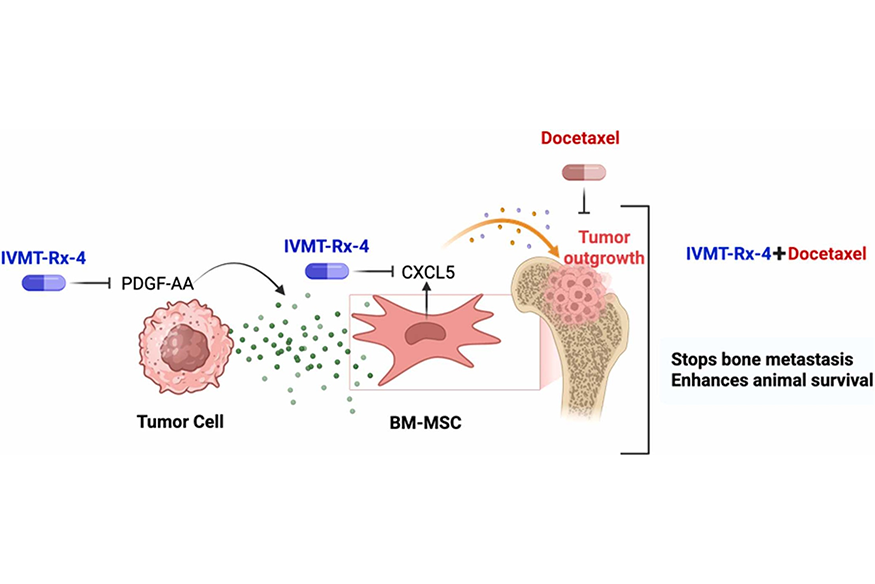 New study findings show that IVMT-Rx-4, a targeted small molecule inhibitor, effectively prevents prostate tumors from spreading to an advanced and incurable stage in the bones. (Maji et al., Pharmacological Research)
New findings out of VCU Massey Comprehensive Cancer Center and the VCU Institute of Molecular Medicine (VIMM)— published in Pharmacological Research, ranked among the top pharmacology journals globally—show that an innovative drug effectively prevents prostate tumors from spreading to an advanced and incurable stage in the bones. The targeted small molecule inhibitor, IVMT-Rx-4, also enhances standard-of-care chemotherapy treatment for the disease, offering significant potential for a paradigm shift in the treatment of metastatic tumors.
“Developing effective therapies for prostate cancer bone metastasis—a final stage of prostate cancer progression without any effective treatments—is a medical priority,” said study co-leader Paul B. Fisher, MPH, Ph.D., FNAI, the Thelma Newmeyer Corman Endowed Chair in Cancer Research at Massey and the founding and current director of the VIMM.
Prostate cancer is the most commonly diagnosed cancer in men in the U.S., excluding skin cancer. Through early detection and advanced treatment options, most men with prostate cancer will not die from it. However, once prostate cancer spreads to the bone, it becomes much more difficult to treat without curative options, contributing to skeletal problems, poor quality of life and, in many cases, death.
Bone metastasis involves a complex process through which cancer cells embed themselves in the bone tissue, and then form physical and functional relationships with the surrounding connective tissue, promoting tumor growth and disrupting the structural integrity of the bones. The research team at Massey and the VIMM knew that identifying the genes responsible for contributing to this interplay between tumors and bone tissue is fundamental to developing an effective treatment strategy for advanced prostate cancer.
Melanoma differentiation associated gene-9 (MDA-9/Syntenin) is a commonly expressed gene in multiple organs that drives the growth and spread of tumors, including prostate tumors, to the bone.
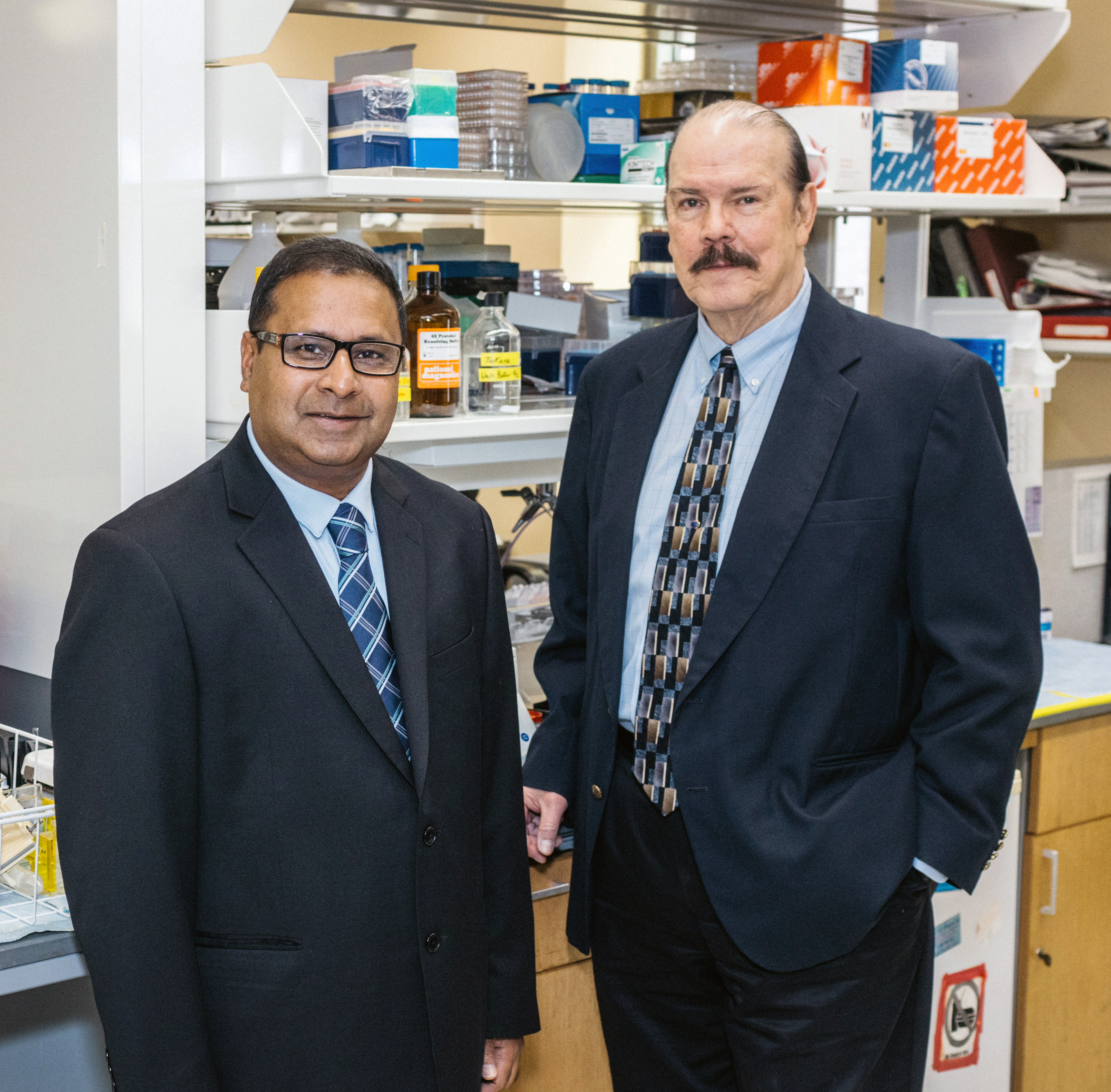 Swadesh K. Das, Ph.D., and Paul B. Fisher, MPH, Ph.D., standing in a laboratory. (Daniel Sangjib Min, MCV Foundation)
“Due to the high mortality rate of prostate cancer bone metastases and the eventual ineffectiveness of traditional treatments, it is imperative to adopt new targets and identify effective therapeutics focused on these targets; MDA-9/Syntenin is such a target,” said study co-leader Swadesh K. Das, Ph.D., member of the Cancer Biology research program at Massey, a member of the VIMM and an associate professor in the Department of Cellular, Molecular and Genetic Medicine at the VCU School of Medicine.
Previous work by Fisher and his team was the first to successfully clone MDA-9/Syntenin and uncover it as a promising target for innovative cancer therapies. Through this latest work, the research team found that a small molecule drug called IVMT-Rx-4 effectively blocked the function of MDA-9/Syntenin and prevented prostate tumors from spreading to the bone, with no visible toxicity, in preclinical models. This inhibition is achieved, in part, by interfering with the interaction of two proteins—PDGF-AA and CXCL5—that are critical to the overall function of MDA-9/Syntenin.
The research team also determined that the combination of IVMT-Rx-4 and docetaxel—an approved intravenous chemotherapy drug widely used as a first-line treatment option for prostate cancer—improved survival in models of prostate cancer that had migrated to the bone.
“Our work suggests that IVMT-Rx-4 can amplify the effectiveness of standard-of-care treatment and provides a new framework for translational strategies to improve significant health complications associated with advanced prostate cancer,” said Fisher, who is also a professor in the Department of Cellular, Molecular and Genetic Medicine at the VCU School of Medicine.
Fisher previously received grant funding from the National Cancer Institute (NCI) to evaluate the efficacy of a drug called PDZ1i, developed in-house at the VIMM, to target the role of MDA-9/Syntenin. IVMT-Rx-4 is an intermediate synthesis product of PDZ1i, kind of like a molecular building block on the way to fully becoming PDZ1i. IVMT-Rx-4 demonstrates improved therapeutic properties in comparison to unmodified PDZ1i, including an increased ability to dissolve in water, lower susceptibility for tumor resistance and no associated toxicity.
Looking ahead, with support from Massey and the VIMM, the research team anticipates the potential to study this inhibitor in the clinic in 2027.
This latest research was supported by funding from the NCI, the Human and Molecular Genetics Development Fund at VCU, the VIMM, a sponsored research agreement with InVaMet Therapeutics, Inc., as well as the Commonwealth Health Research Board.
Additional VCU collaborators on this study include Jiong Li, Ph.D., and Nitai D. Mukhopadhyay, Ph.D., members of the Cancer Biology research program at Massey; as well as Santanu Maji, Ph.D., Maddie Gunawardena, Amit Kumar, Ph.D., Padmanabhan Mannangatti, Ph.D., Jinkal Modi, Ph.D., Rudra Pangeni, Ph.D., and Qingguo Xu, D.Phil.
Scientists from Virginia Tech, including Marion Q. LoPresti, Anne M. Brown, Ph.D., and Webster L. Santos, Ph.D., (an affiliate VIMM member) also collaborated on the research.
Written by: Blake Belden
Related News
Research & Innovation, Clinical Care
Massey plays key role in helping create new therapeutic standard for patients with stage III colon cancerMar 31, 2026
Research & Innovation
Massey researchers lead international collaboration of first-ever, multi-platform digital atlas of oral tissuesMar 23, 2026
Research & Innovation, Clinical Care, Prevention
Colorectal Cancer Awareness Month: Q&A with Dr. Khalid MatinMar 18, 2026

Get access to new, innovative care
Treatments in clinical trials may be more effective or have fewer side effects than the treatments that are currently available. With more than 200 studies for multiple types of cancers and cancer prevention, Massey supports a wide array of clinical trials.

Find a provider
Massey supports hundreds of top cancer specialists serving the needs of our patients. Massey’s medical team provides a wealth of expertise in cancer diagnosis, treatment, prevention and symptom management.