Latest News
Research & Innovation
Scientists develop sugar-based molecule to target cancer’s ‘hibernating bears’
Jan 22, 2026
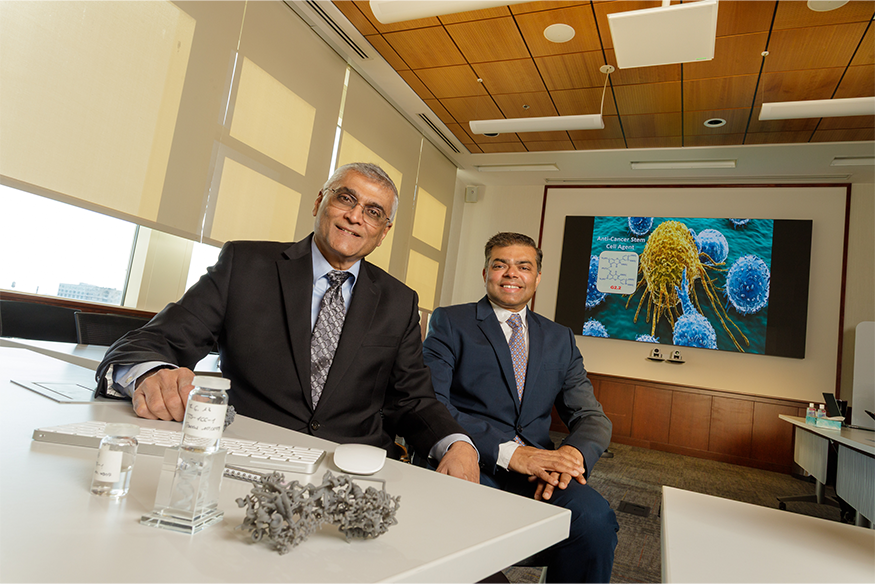 Umesh Desai, Ph.D. (left), and Bhaumik Patel, M.D., members of the Developmental Therapeutics research program at VCU Massey Comprehensive Cancer Center, are developing novel therapies that target cancer stem cells to help prevent tumor recurrence. (Photo: Karl E. Steinbrenner)
For more than three decades, Umesh Desai, Ph.D., a member of the Developmental Therapeutics research program at VCU Massey Comprehensive Cancer Center, has investigated one of biology’s most intricate and least understood molecular families – and the potential to prevent cancer relapse.
Desai and Bhaumik Patel, M.D., a physician-scientist at Massey who studies colorectal and other gastrointestinal cancers, have pioneered development of a VCU-owned molecule. Nicknamed G2.2, the molecule targets colorectal cancer stem cells, and ongoing pre-clinical studies are a key step toward an Investigational New Drug submission to the Food and Drug Administration.
“Even today, people don’t fully understand glycosaminoglycans,” Desai said, referring to the long, sugar-based polymers that coat the surface of virtually every human cell, where they regulate processes from blood clotting and inflammation to growth and immune signaling. “There is so much unknown and unexplored around GAGs. The critical thing that I have tried to bring about in this field is to think of glycosaminoglycans as potential drugs and therapeutic agents.”
For Desai, professor and chair of the Department of Medicinal Chemistry in the VCU School of Pharmacy, and others around the world studying GAGs, their structural complexity and importance in maintaining normal biology make them a promising target for drug discovery.
Desai’s laboratory at the VCU Center for Drug Discovery is developing synthetic versions of GAGs that mimic natural ones. The goal is to create drugs that maintain therapeutic power while avoiding the variability and toxicity associated with natural forms of GAGs, such as the blood thinner heparin. His group has published more than 200 peer-reviewed papers, holds multiple patents and is widely recognized for advancing this specialized area of medicinal chemistry.
“Cancer relapses. Patients walk out of surgery or chemotherapy thinking they are free of cancer, and five years later, it relapses intensely,” Desai explains. “Cancer stem cells are essentially like a hibernating bear. During wintertime, the bear enters the den and hibernates…Chemotherapy and radiation don’t touch cancer stem cells because they are essentially hibernating.”
Desai and Patel believe G2.2 represents a new approach to treatment, with the molecule drawing cancer stem cells out of dormancy and then destroying them.
Through a series of studies spanning more than a decade, Desai and Patel discovered that G2.2 mimics a specific GAG fragment that interacts with a key regulator of cancer cell survival. By binding to that receptor, G2.2 disrupts downstream signaling and activates a pathway that forces cancer stem cells into death.
Desai and Patel say G2.2 can be used in conjunction with chemotherapy or on its own to prevent cancer relapse.
“In multiple preclinical models, we’ve observed a near-complete elimination of dormant cancer stem cells in colorectal cancer, with similar activity seen in lung, brain, renal and pancreatic cancers,” Patel said.
G2.2 also shows a strong safety profile and seems to stimulate the immune system, triggering antigen-reactive T-cells that enhance the body’s own anti-tumor defenses.
“When you see a discovery like G2.2, you realize the power of long-term research,” said Magdalena Morgan, Ph.D., director of licensing at VCU TechTransfer and Ventures, which has secured domestic and international patent protection and facilitated engagement with potential industry partners. “G2.2 is not just a molecule, but a platform that could change how we think about preventing cancer recurrence. Supporting projects like this is why we do what we do.”
Desai and Patel’s research is supported by the National Institutes of Health, the Department of Veterans Affairs and the VCU Office of the Vice President for Research and Innovation’s Commercialization Fund.
For Desai, whose career has bridged chemistry and medicine, G2.2 represents a proof of concept – that rationally designed carbohydrate mimetics can modulate complex biological systems with precision. If successful, this approach could redefine how medicine targets not only cancer relapse but also clotting disorders, inflammation and viral infections.
“My work is exciting, the work is rewarding, and we believe it will be even more rewarding in the next few years as we hope to realize this molecule’s potential,” Desai said. “VCU and Massey have been incredibly supportive. Work is fun when one is supported.”
This was repurposed from an article originally published by VCU News.
Written by: Jeff Kelley
Related News
Research & Innovation, Clinical Care, Community Engagement
Leaps and bounds in radiation oncology: Putting patients at the center of their cancer careMar 10, 2026
Research & Innovation
Researchers identify Achilles’ heel in lung cancer through common p53 genetic mutationMar 9, 2026
Research & Innovation
Neighborhood factors related to financial stress are linked to worse breast cancer outcomes; interventions could improve survivorshipFeb 18, 2026

Get access to new, innovative care
Treatments in clinical trials may be more effective or have fewer side effects than the treatments that are currently available. With more than 200 studies for multiple types of cancers and cancer prevention, Massey supports a wide array of clinical trials.

Find a provider
Massey supports hundreds of top cancer specialists serving the needs of our patients. Massey’s medical team provides a wealth of expertise in cancer diagnosis, treatment, prevention and symptom management.