Latest News
Clinical Care, Patient Stories
Breast cancer survivor heals her heart, leans into advocacy for others
Dec 1, 2025
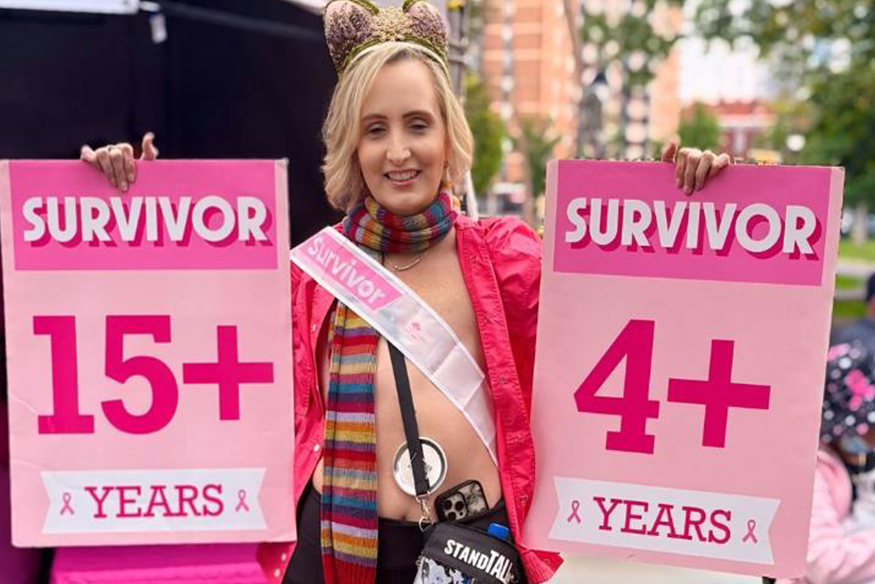 Beth Rutherford, a breast cancer survivor and advocate, was treated by the multidisciplinary cardio-oncology specialists at the VCU Health Pauley Heart Center and VCU Massey Comprehensive Cancer Center. (Contributed photo)
Beth Rutherford’s bold and unflinching energy is apparent the moment she walks into a room wearing a bright yellow jacket that reads, “TAKE UP SPACE.”
A fighter and survivor, the 54-year-old has been through the wringer with multiple breast cancer diagnoses and a diagnosis of advanced melanoma. Rutherford has endured chemotherapy, radiation and multiple surgeries, including a mastectomy with reconstruction. After she received breast implants, she experienced severe complications that resolved only after she had the implants removed in 2019.
“You don’t go back to who you were before cancer,” she said. “You become someone new — and that’s okay.”
Quick witted, sharp-tongued and deeply honest, Rutherford takes up space in any room she goes in and tells it like it is.
“My first doctor would talk to my husband instead of me,” she said, explaining what the bedside manner was like during her initial cancer treatment in 2007 at another hospital. “I had to say, ‘Over here dude, I’m the patient.’”
But after spending years advocating for herself, Rutherford faced a new challenge – healing her heart.
About a year after “going flat” and removing her post-mastectomy breast implants, Rutherford began experiencing chest pain. A CT scan revealed she had fractured her sternum during a recent trip — and new issues with her heart.
That’s when Rutherford was referred to the multidisciplinary cardio-oncology specialists at the VCU Health Pauley Heart Center and VCU Massey Comprehensive Cancer Center.
“Beth’s case is complex. She had been through so much — multiple cancers, recurrences, surgeries and the long-term effects of treatment,” said Wendy Bottinor, M.D., MSCI, who is Rutherford’s cardio-oncologist at Pauley, as well as a physician-researcher at Massey. “But what stood out to me was how high functioning she was despite it all. She was taking care of her daughter, managing her household and still always showing up for herself.”
.jpg) Pictured: Wendy Bottinor, M.D.
Pictured: Wendy Bottinor, M.D.
Rutherford’s heart problems were likely a delayed side effect of doxorubicin, a chemotherapy drug that is known to be cardiotoxic. She was ultimately diagnosed with heart failure.
Multidisciplinary care drives cardio-oncology excellence at VCU Health
From the start, Rutherford noticed a difference in her care at VCU Health compared to other hospitals she’s been to. During her cancer journey, Beth had some unpleasant moments with other doctors.
“My experience at VCU Health has been entirely different — especially under Dr. Bottinor’s care. The integration between oncology and cardiology, and the compassion behind every decision truly reflects what modern survivorship care should be,” she explained. “It’s the kind of teamwork and attention that helps patients feel seen, heard and supported through every stage.”
The cardio-oncology team at Pauley collaborates with experts at Massey to provide seamless heart care before, during and after cancer treatment. Cancer treatments can impact heart health, especially if a patient has any pre-existing conditions, like high blood pressure or high cholesterol, or have a family history of heart disease.
As part of a university-based health system, VCU Health participates in national clinical trials to test new treatments for heart disease. Rutherford enrolled in a clinical trial led by Bottinor at VCU Health, known as TREAT HF. The study is investigating whether early intervention with heart medications could prevent further damage to the heart in cancer patients and cancer survivors.
“She actually felt a lot better on sacubitril-valsartan (the medication being tested in the clinical trial),” said Bottinor, who a cancer prevention and control researcher who treats patients in affiliation with Massey. “Her MRIs improved, and her symptoms eased.”
Today, Rutherford routinely checks in with Bottinor at follow-up appointments to make sure that her heart stays strong as she continues to navigate her oncology care. Because the risk of heart disease is higher for cancer survivors, Rutherford will likely see a cardio-oncologist for the rest of her life.
Not just surviving, but living
Rutherford learned to advocate for herself during her years of cancer treatment and also became an advocate for others as a caregiver; one of her children lives with a disability.
“That’s a major part of my story, and why I speak out – not just as a patient, but as a mother navigating systems that don’t always see us,” she said.
It took years for Rutherford to feel seen and heard in medical spaces. When she met with doctors about problems with her breast implants at another hospital, she felt like she wasn’t being taken seriously.
“I’m not trying to make anyone feel bad about getting implants,” she said. “I had them. I really do get it. But if you’re having symptoms [with the implants] and [your doctors are] telling you you’re crazy — it might not be in your head.”
So, she leaned into advocacy — not only for herself, but for other breast cancer and cardio-oncology patients. Rutherford began advocating for breast implant illness, flat visibility and survivorship equity, sharing the complicated story of her breast cancer diagnosis and health problems caused by breast implants. She speaks at community events, participates in Heart Month campaigns and even walked in a fashion show to raise awareness about the stigma women face if they don’t have breasts.
After a mastectomy, some people choose to undergo breast reconstruction to restore the shape of the breast, while others opt for aesthetic flat closure, which smooths the chest wall without reconstruction. Some may even choose to “go flat” without reconstruction or aesthetic flat closure — this is the route Rutherford chose.
“I’m trying to get more into the culture of [the “flat”] community,” she said. “Not just surviving, but living and helping others live, too,” she said. “You don’t have to be reconstructed to be whole.”
Bottinor echoes that sentiment. “Survivorship isn’t necessarily about trying to return to the person you were before diagnosis,” she said. “It’s about embracing who you are now. Beth is a great example of that. She’s proud to share her experience and her decision to go flat. She’s not trying to look like she did before — she’s accepting how her body is now.”
Today, Rutherford continues to advocate for better care, more awareness and a health care system that listens to patients. She’s a voice for the flat community (affectionately called “flatties”), a champion for cardio-oncology and a reminder that healing isn’t just about medicine — it’s about meaning.
As someone who has witnessed Rutherford’s journey to become an advocate, Bottinor puts it best: “Beth has taught me that survivorship isn’t about going back — it’s about moving forward. And she’s doing that with courage and a lot of heart.”
This was repurposed from an article originally published by VCU Health.
Written by: Tanner Lambson and Sara McCloskey-Nieves
Related News
Research & Innovation, Clinical Care, Community Engagement
Clinical trials: Shaping the standard of cancer care for the countryFeb 9, 2026

Get access to new, innovative care
Treatments in clinical trials may be more effective or have fewer side effects than the treatments that are currently available. With more than 200 studies for multiple types of cancers and cancer prevention, Massey supports a wide array of clinical trials.
Find a provider
Massey supports hundreds of top cancer specialists serving the needs of our patients. Massey’s medical team provides a wealth of expertise in cancer diagnosis, treatment, prevention and symptom management.