Latest News
Research & Innovation
Simulating cellular environments to fight advanced prostate cancer
Oct 7, 2026
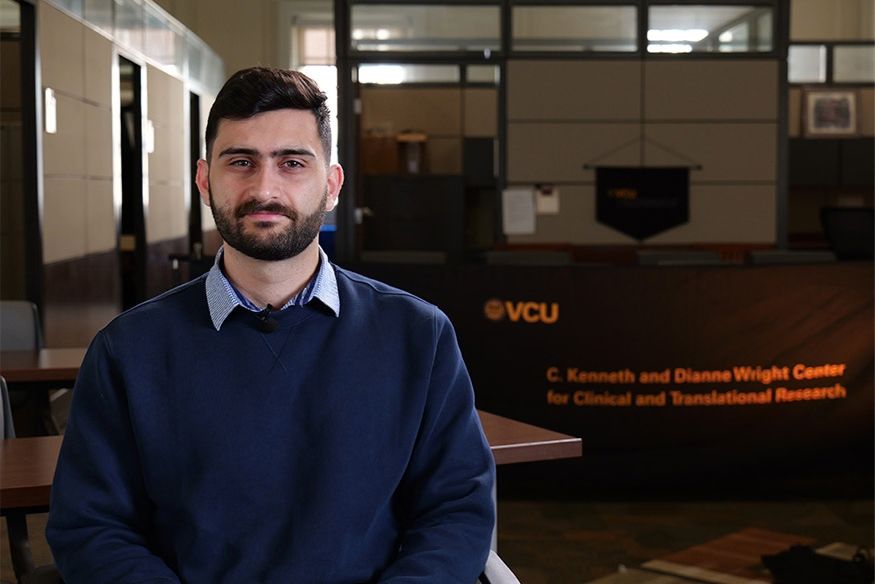 Gevick Safarians is a third-year M.D.-Ph.D. student in the VCU School of Medicine’s Medical Scientist Training Program. (Credit: Christopher Richmond)
Gevick Safarians remembers the conversations. Patients dealing with cancer and other diseases with very poor prognoses, hoping not for years but for months — a little more time to settle their affairs, to figure out who would care for their pets. Those encounters stayed with him.
"Patients that are dealing with cancer deserve that added chance in life," said Safarians, a third-year M.D.-Ph.D. student in VCU School of Medicine’s Medical Scientist Training Program. "And I see myself, with my training, in a unique position to be that person for them."
That sense of purpose is what brought Safarians to the Wright Center's Translational Biomedical Sciences T32 Training Program, a federally funded fellowship supported by the National Center for Advancing Translational Sciences at the National Institutes of Health, that prepares predoctoral researchers to connect laboratory discovery with patient care. As a T32 trainee, Safarians is doing exactly that: bridging engineering and medicine to bring the three-dimensionality of the human body into the lab, one controlled variable at a time.
A chip the size of a thumbnail
Safarians works in the lab of Priscilla Hwang, Ph.D., member of the Cancer Biology research program at VCU Massey Comprehensive Cancer Center and an associate professor in the Department of Biomedical Engineering at the VCU College of Engineering, whose research focuses on developing 3D microphysiological systems to study cancer progression and collective cell migration.
“Having Gevick on our team has been fantastic. His training as a physician-scientist allows him to bridge the gap between engineering and medicine—combining his clinical perspective as an M.D. student with his background in biomedical engineering to design microfluidic systems that truly replicate what happens inside the body,” Hwang said. “That dual expertise allows him to look at metastatic cancer from both an engineering standpoint and a patient-centered clinical lens.”
Safarians’ focus: metastatic prostate cancer, and the steep drop in survival odds that comes with it.
"[When] it's localized and you're able to catch it early, you see about a 90% survival over the course of five years," Safarians explains. "But there are situations where metastasis can happen — and for those patients, unfortunately, five-year survival drops to just around 30 to 37%. And that's what's driving the need to create more therapeutic opportunities."
Part of what makes metastatic prostate cancer so difficult, Safarians said, is the sheer variety of environments the cancer passes through.
“It's very heterogeneous in terms of the environments it experiences in the body — starting from the prostate, then metastasizing through the blood, reaching places like the bone, liver or lungs,” he said. “All of these places have different landscapes, and in those landscapes, there are many features that may be affecting the tumor: making it more metastatic, more proliferative or even treatment resistant.”
The long road from chip to clinic
The Wright Center's T32 program is pushing Safarians to think beyond the bench. Through coursework in community-engaged research and team science, a clinician mentorship component focused on clinical trial design, and a community mentor pairing, the fellowship asks its scholars to grapple with a question that's important to keep front of mind in the lab: Who does this work ultimately serve, and are they part of the conversation?
“The definition of translational science is completely changing,” Safarians said. “Now we're seeing scientists and engineers trying to work with community members — teachers, coaches, religious leaders, community advisory boards — to help formulate research questions that are more applicable to the communities they hope to serve.”
That shift resonates with him. A breakthrough that patients don't trust or have never been asked about is a breakthrough that falls short.
“Until people are a part of that process and see the behind the scenes — if they don't have that belief — it's almost like that technology never even existed,” he said. “Involving people is very critical.”
For Safarians, the patients he remembers from his clinical training are the reason every piece of this matters — the microfluidics, the T32, the community partnerships and the long road from chip to clinic. He is still early in that journey. But he knows exactly why he's on it.
This was repurposed from an article originally published by VCU News.
Written by: Christopher Richmond
Related News
Research & Innovation
VCU Massey researchers receive $2.5M NIH grant to inform breast, pancreatic cancer careSep 9, 2026

Get access to new, innovative care
Treatments in clinical trials may be more effective or have fewer side effects than the treatments that are currently available. With more than 200 studies for multiple types of cancers and cancer prevention, Massey supports a wide array of clinical trials.
Find a provider
Massey supports hundreds of top cancer specialists serving the needs of our patients. Massey’s medical team provides a wealth of expertise in cancer diagnosis, treatment, prevention and symptom management.