
Latest News
Community Engagement, Prevention , Patient Stories
Closing the gap for disparities in prostate cancer prevention, care and survivorship
Sep 29, 2026
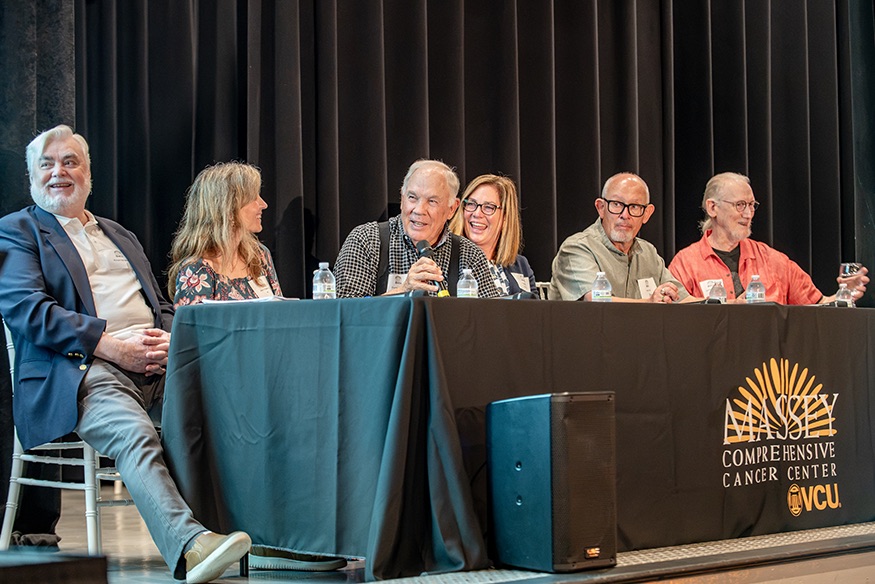 A panel featuring prostate cancer survivors and cancer experts shared questions, concerns and ideas to help shape the future of prostate cancer care and community outreach. (Photo: Terry Brown)
Henry Ardiff was diagnosed with prostate cancer in 2021, he was unsure if he had three months, three years or three decades to live.
Years later, after being treated at VCU Massey Comprehensive Cancer Center, “where the experts are,” he reported that he currently exhibits no evidence of disease.
Following his treatment, Ardiff has been able to travel internationally, attend the weddings for both of his daughters and witness the birth of his first grandchild.
Despite his cancer, “the last five years have been the best of my life,” Ardiff said as he expressed gratitude toward his oncologist, Asit Paul, M.D., Ph.D.
Ardiff shared this story in front of an audience at Massey’s Closing the Gap Prostate Cancer Summit in South Hill in September, a public gathering intended to bring together community members, healthcare providers, advocates, researchers and clinicians to address various topics related to prostate cancer.
Monica L. Baskin, Ph.D., FSBM, FABMR, the director and Lipman Chair in Oncology at Massey, said that informational events like this are an important way “to make sure that we are constantly reminded that community is at the center of everything we do.”
“I encourage each and every one of us to listen, to speak, to ask questions,” Baskin said. “Together, we are strengthening the connection between community and science and advancing our shared goal of closing the gap in cancer prevention, care and outcomes.”
Prostate cancer in Virginia
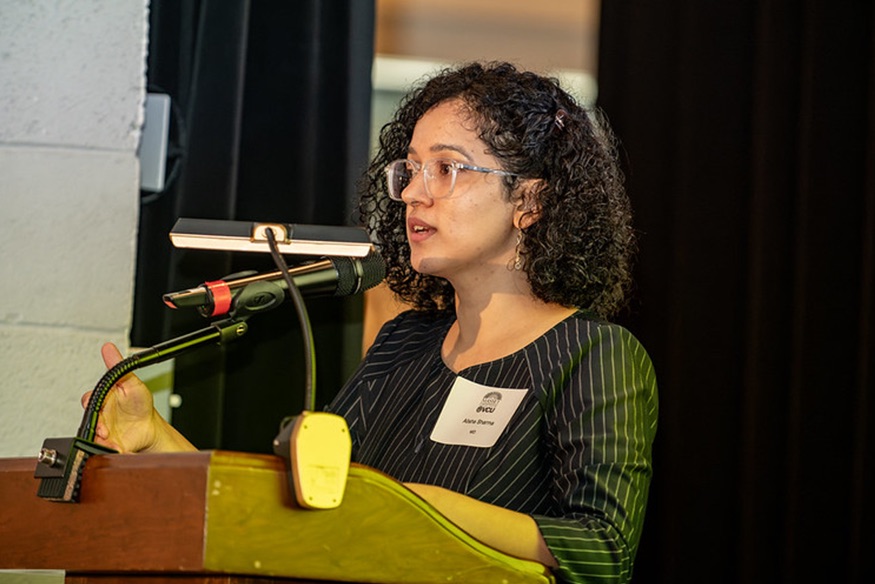 Alisha Sharma, M.D., FACP (Photo: Terry Brown)
Alisha Sharma, M.D., FACP, hospitalist at VCU Health, and Meghan Tipre, DrPH, the assistant director of Catchment Area Data Analytics at Massey, led a data-informed presentation on the state of prostate cancer in the U.S., Virginia and within Massey’s catchment area—the 66 localities primarily served by the cancer center.
Alisha Sharma, M.D., FACP (Photo: Terry Brown)
Alisha Sharma, M.D., FACP, hospitalist at VCU Health, and Meghan Tipre, DrPH, the assistant director of Catchment Area Data Analytics at Massey, led a data-informed presentation on the state of prostate cancer in the U.S., Virginia and within Massey’s catchment area—the 66 localities primarily served by the cancer center.
Prostate cancer is the most common non-skin cancer among men in the U.S., where about one in eight men will be diagnosed in their lifetime, and it is the second leading cause of male cancer death in the country.
Although prostate cancer deaths are on the decline overall, significant disparities remain, and Massey’s catchment area carries a substantial prostate cancer burden, with a higher incidence and mortality rate when compared to all of Virginia. Black men in the catchment area experience nearly double the overall incidence and late-stage diagnosis than white men. Petersburg holds the fourth highest mortality rate for prostate cancer in the country.
Sharma said that there are a wide number of factors that contribute to these disparities, including varying access to prevention, diagnosis and treatment resources across different communities.
“We have to move forward with the community to help decrease that gap,” Sharma said.
No two diagnoses are the same
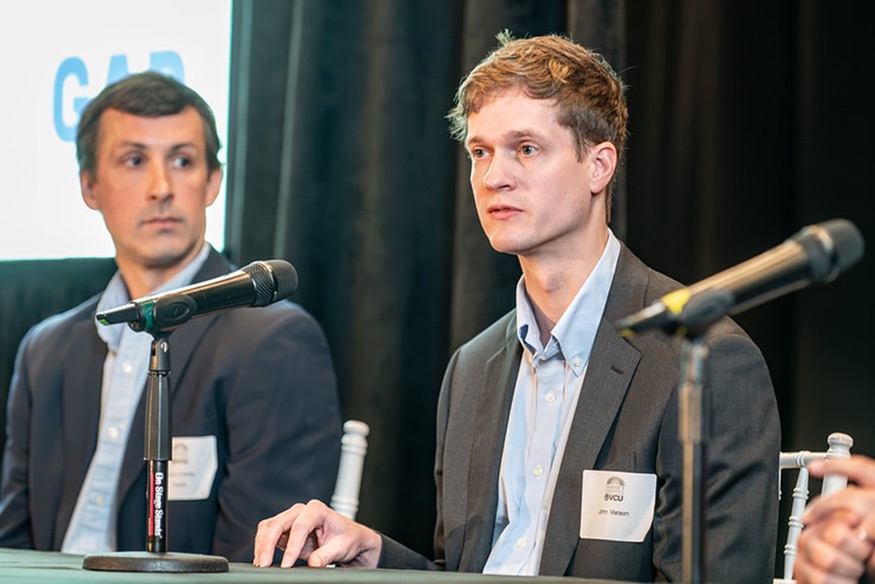 John Melson, M.D. (Photo: Terry Brown)
Medical experts elaborated on the cutting-advancements in prostate cancer treatments through the lens of urology, radiation oncology, medical oncology and side effect mitigation.
John Melson, M.D. (Photo: Terry Brown)
Medical experts elaborated on the cutting-advancements in prostate cancer treatments through the lens of urology, radiation oncology, medical oncology and side effect mitigation.
Session panelists:
- Jared Crumb, PharmD, clinical pharmacist at VCU Health
- Alex Kenigsberg, M.D., director of urologic oncology at Massey
- John Melson, M.D., medical oncologist at Massey
- Alfredo Urdaneta, M.D., radiation oncologist at Massey
There are many advanced options and strategies when it comes to prostate cancer treatment and management, with the ultimate goal of prolonging life, managing symptoms and protecting overall quality of life through individualized precision medicine. Risk factors such as age, race or family history can inform a more effective treatment plan for each patient.
“No two prostate cancer diagnoses are the same, and we need to account for that,” Melson said.
Kenigsberg stressed the importance of early detection in saving lives, as prostate cancer does not always present with symptoms until it has spread to other organs, when the disease is harder to treat.
“We need to reduce the stigma around screening,” Kenigsberg said. “We don’t use our fingers anymore. We use a simple blood test.”
Even if the blood test indicates signs of a tumor, Kenigsberg said that many patients don’t need to do anything invasive and can actively monitor their cancer.
“Ask about a prostate MRI before a biopsy,” Kenigsberg emphasized.
Learn more about prostate cancer treatment options at Massey
Prostate cancer research and clinical trials
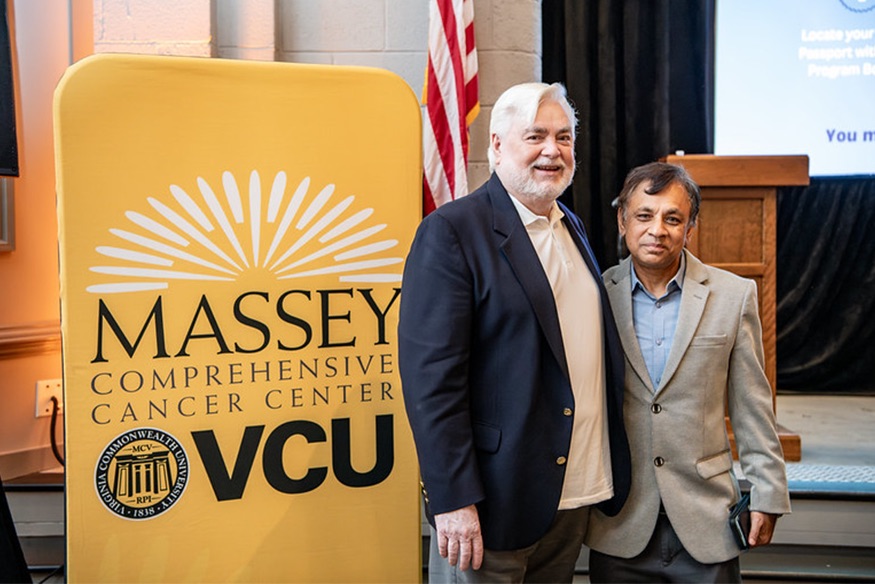 Richard Mansfield and Asit Paul, M.D., Ph.D. (Credit: Terry Brown)
A morning panel session during the summit offered attendees the chance to discover the latest research and clinical trials at Massey, as well as a patient’s firsthand account of participating in a study.
Richard Mansfield and Asit Paul, M.D., Ph.D. (Credit: Terry Brown)
A morning panel session during the summit offered attendees the chance to discover the latest research and clinical trials at Massey, as well as a patient’s firsthand account of participating in a study.
Session panelists:
- Kaustubh Datta, Ph.D., member of the Cancer Biology research program at Massey
- Richard Mansfield, prostate cancer patient
- Asit Paul, M.D., Ph.D., physician-researcher at Massey
Datta presented his lab’s research studying a new genetic target—NRP2—in an effort to understand why prostate cancer grows, spreads and resists treatment, and to inform the development of new targeted therapies for hard-to-treat tumors.
Paul explained how clinical trials are an imperative means of translating basic science like Datta’s to better understand disease so that it can be treated more effectively in the clinic. He provided an overview of the numerous prostate cancer clinical trials ongoing at Massey, including some that investigate the use of genetic testing to target molecular alterations, the role of prostatectomy in comparison to radiation to treat advanced disease, the effectiveness of chemotherapy when used in combination with hormone treatment, using vitamin D to boost bone health, among many others.
Mansfield, a clinical trials participant who was treated by Paul, shared for the first time publicly how he had no family history and no symptoms when he was diagnosed with advanced prostate cancer at age 70. It had spread to his lymph nodes, groin and vertebrae. In October 2021, he received a second opinion at Massey and, after a lot of deliberation, decided to join a clinical trial, a decision that ultimately led to an undetectable PSA level for the last few years and allowed him to return to a life of socializing, traveling and exercising.
“I thought sure I was going to be dead in three months, but I’m not, I’m still here,” Mansfield said.
Learn more about available clinical trials at Massey
A local problem needs a local solution
The American Cancer Society recommends that men start having discussions about prostate cancer screening with their providers at:
- Age 50 for men who are at average risk
- Age 45 for men at high risk, including African American men and individuals who have a parent, full sibling or child diagnosed at an early age
- Age 40 for men at an even higher risk, including men with multiple first-degree relatives diagnosed with prostate cancer
John Quillin, Ph.D., genetic counselor at Massey, said that all prostate cancers have genetic mutations, and genetics evaluation is standard of care when there is metastatic cancer in the family.
“Knowing about genetic mutations in tumors guides treatment,” Quillin said. “Learn your family history. Ask questions. Talk with your healthcare team and your family.”
During the summit, TJ Wallace, M.D., Ph.D., who leads Massey’s radiation oncology services at VCU Health Community Memorial Hospital in South Hill, announced the launch of Massey’s Southside Prostate Awareness and Rural Screening (SPARCS) initiative. This is a targeted effort to bring prostate cancer awareness, screening and follow-up care resources to three rural counties—Brunswick, Lunenburg and Mecklenburg—with elevated cancer rates.
“A local problem needs a local solution,” Wallace said. “By combining accessible early detection with coordinated follow-up care and navigation, this initiative has the potential to reduce prostate cancer disparities, improve survival rates and serve as a replicable model for rural cancer prevention across the region.”
As part of this ongoing effort, Massey offered free PSA testing for eligible community members on site during the summit.
Early detection saves lives. Find out if you’re eligible for prostate cancer screening today.
The impacts of physical, mental and spiritual health on cancer
Samantha Haswell, MS, a Massey dietitian, explained how nutrition affects cancer development, where plant-based diets offer protection against all cancer types, and risk factors include obesity, high-fat diets and diets high in meat consumption, particularly processed meats.
Alex Lucas, Ph.D., a member of the Cancer Prevention and Control research program at Massey, discussed the benefits of “precision exercise,” where exercise and resistance training can be a behavioral intervention that helps protect health and function during cancer treatment.
“The healthier you are when you are diagnosed with prostate cancer, the more resilience that you have,” Lucas said.
Sheldon Barr, MSN, MBA, the president of VCU Health Community Memorial Hospital; Sonja Hegeman, NP, the assistant director of the Cancer Survivorship Program; Charles Hubbard, a prostate cancer survivor; and Joshua Rockett, MDiv, MS, a Massey chaplain, participated in a panel conversation on survivorship, mental health and spiritual support as it relates to cancer care.
The summit closed with an interactive panel discussion moderated by Kim Rhoads, M.D., MS, MPH, the associate director of community outreach and engagement at Massey. This panel featured four prostate cancer survivors and Massey experts who shared questions, concerns and ideas to help shape the future of cancer care and community outreach.
Written by: Blake Belden
Related News
Clinical Care, Prevention , Patient Stories
Cancer care in Southside Virginia: Alan Veeck’s prostate cancer journeySep 21, 2026
Clinical Care, Patient Stories
Riley’s vibrant smile and humongous hugs leave a lasting impressionSep 16, 2026
Community Engagement, Giving
Adrienne Maxwell builds a movement around VCU Massey by bringing people inAug 24, 2026

Get access to new, innovative care
Treatments in clinical trials may be more effective or have fewer side effects than the treatments that are currently available. With more than 200 studies for multiple types of cancers and cancer prevention, Massey supports a wide array of clinical trials.

Find a provider
Massey supports hundreds of top cancer specialists serving the needs of our patients. Massey’s medical team provides a wealth of expertise in cancer diagnosis, treatment, prevention and symptom management.