Latest News
Patient Stories
From artist to patient: Mural project takes a personal turn
Apr 15, 2026
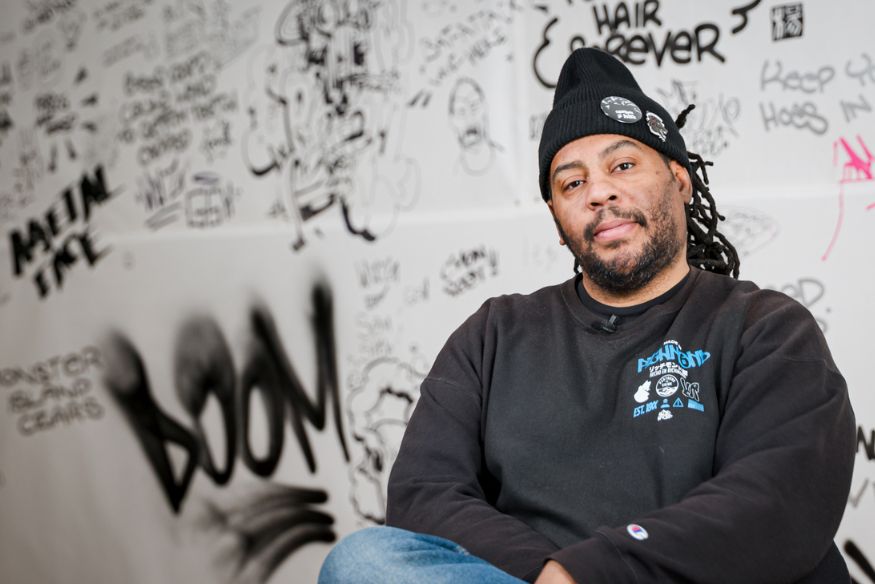
When local artist Silly Genius agreed to participate in VCU Massey Comprehensive Cancer Center’s Brushstrokes of Discovery art project early last year, he never imagined that just six months later he’d end up becoming a patient at Massey himself.
In that short time after signing up to participate in this special Massey initiative to spread awareness on cancer research, he discovered a mass below his ear in his neck. At first, he chalked it up to aging and normal symptoms of getting older. It didn’t cause him any pain, but it didn’t go away.
Genius decided it was worth getting it checked out, and it’s a good thing he did.
Looking for answers
With a close friend who had gone through treatment at Massey and his own connection with Massey researcher Jennifer Koblinski, Ph.D., for the Brushstrokes of Discovery project, Genius naturally felt inclined to turn to the same place for his care.
In March, he received an initial examination by Thomas Lee, M.D., an otolaryngologist on Massey’s head and neck cancer treatment team. Lee discovered that Genius had a mass on his parotid gland, which is the largest salivary gland in front of the ear. After going through CT scans and biopsies to assess his condition, his team determined the mass needed to be removed.
In May 2025, Genius underwent surgery. Fortunately, the mass itself was found to be benign. However, his doctors did find some low-grade cancer cells, so he wasn’t fully in the clear.
“I went to the hospital thinking it was probably just some sort of crazy bump, and then immediately having this cancer scare,” Genius said.
To treat the low-grade cells, he needed six weeks of daily radiation to target and destroy any remaining cancer cell DNA.
The treatment process
While many people expect side effects of treatment to be the most harrowing part of cancer care, for Genius, it was actually the preparation before he could even begin.
Before starting radiation therapy, he learned that he needed to get his wisdom teeth removed.
“That was probably the most painful part of the whole process,” Genius said. “I had to get six teeth removed before I could even start radiation.”
Since radiation impacts blood supply and can cause devitalized bone, this is actually a common procedure to prevent any future complications following treatment to the head and neck.
After recovering from this unexpected obstacle, he began radiation treatments with Shiyu Song, M.D., one of Massey’s radiation oncologists specializing in head and neck cancers.
While each session only lasted around 10 minutes, this addition to his daily routine had a sobering effect on him.
“It made me more cognizant of the fragility of life, honestly,” said Genius. “I'm not 25 anymore, and I'm at peace with the chronological passing of time. You think you're in good health, and then all of a sudden, things could have gone another way.”
While he is now in good health, he will have to continue routine CT scans every six to 12 months to ensure the mass doesn’t return.
“While the treatment is challenging, the good thing is that we have a lot of resources and a huge team to take care of a single patient, including medical oncologists, radiation oncologists, nurse navigators, social workers, speech pathologists, as well as other nurses and doctors,” said Song. “It is a huge team that provides a lot of resources to support patients going through the whole treatment and makes the work more efficient and cohesive.”
Spreading awareness
Just a few weeks after completing his radiation treatment, Genius helped launch Massey’s Brushstrokes of Discovery project, creating much more of a personal experience than he initially anticipated. He and two other local artists worked together on a mural to raise awareness on the importance of tumor tissue samples in cancer research and celebrate the relationships between patients and researchers.
The project was led by Koblinski, an associate professor in VCU’s Department of Pathology, and Nina Dashti-Gibson, M.D./Ph.D. candidate in VCU’s School of Medicine.
As a self-proclaimed science lover with his own inspiring experience at Massey, this opportunity provided Genius with a fresh perspective on the importance of art and community.
“I think art is a universal language,” Genius said. “So even if you don't quite understand the written or spoken word, the art can communicate. It was cool to be a part of the Brushstrokes of Discovery project and share insight into cancer research and apply some of what I do to communicate those efforts.”
Fostering community
To continue engaging with the community he calls home, Genius recently co-developed HI-RES, a new gallery near downtown Richmond.
The gallery is a collaborative space which will serve multiple functions for local creatives. Alongside showcasing local contemporary art, it will also offer a third space where artists of all kinds can network and learn from each other in an organic way.
“I’m one of those people that never went to school for art,” Genius said. “I’ve just been doing it all my life.”
That’s why he sees such importance in spaces like this, which give natural opportunities for education and growing artistic skills.
“A lot of the magic of art is spontaneity and the magic that happens in the process.
So you need to be in a community to discover that and a lot of things you would never come across on your own. It's the joy of discovery and being in a community of people who see things differently than you.”
In the same way that community is important for artists, it’s also essential for those going through the vulnerable journey of cancer treatment.
“We all go through things and people don't talk, so they feel that they are the only ones going through whatever problems they have. But it's good to talk to people, even if you aren't going through the exact same thing. I had a friend who went to Massey a year or so before me, so it was very easy. It's great to be around people who understand what you're going through so you don’t feel like you're fighting this giant all by yourself.”
Reflecting on his experience, Genius encourages those in similar positions to speak up and be their own advocate.
“Seek help.There’s this masculine idea of being stoic and thinking you don’t need to go to the doctor. The impulse was there to just write it off since I wasn’t in any pain. Had I not gone to the doctor, who knows how this journey might have turned out. I might have waited too long, and it might have metastasized. If you feel something off about yourself, there’s no shame in going to get checked out. The idea of being tough is not worth it.”
Song echoed the same sentiment.
“Stay vigilant of any changes in your body and get medical attention early. We have seen a lot of patients who develop a mass and just ignore it, but then it turns out to be an aggressive tumor. The sooner you get diagnosed, the better your chances of a positive outcome.”
Written by: Tatiana Del Valle
Related News
Clinical Care, Prevention , Patient Stories
Cancer care in Southside Virginia: Alan Veeck’s prostate cancer journeySep 21, 2026
Clinical Care, Patient Stories
Riley’s vibrant smile and humongous hugs leave a lasting impressionSep 16, 2026
Research & Innovation, Clinical Care, Community Engagement, Prevention , Patient Stories , Giving, Leadership
VCU Massey Comprehensive Cancer Center Releases 2025 Annual ReportAug 11, 2026

Get access to new, innovative care
Treatments in clinical trials may be more effective or have fewer side effects than the treatments that are currently available. With more than 200 studies for multiple types of cancers and cancer prevention, Massey supports a wide array of clinical trials.
Find a provider
Massey supports hundreds of top cancer specialists serving the needs of our patients. Massey’s medical team provides a wealth of expertise in cancer diagnosis, treatment, prevention and symptom management.