Latest News
Research & Innovation
How studying oral inflammatory diseases can help researchers understand other human diseases
Jul 9, 2026
A team of researchers from VCU Massey Comprehensive Cancer Center, the VCU School of Dentistry and the University of Pennsylvania recently published a study in Nature Communications examining why some oral inflammatory diseases progress much more rapidly than others.
The study was co-led by Kang I. Ko, D.D.S., Ph.D., of the University of Pennsylvania, Jinze Liu, Ph.D., of VCU, and Kevin Matthew Byrd, D.D.S., Ph.D., of VCU, with co-first authors Quinn T. Easter, Ph.D., and Khoa L.A. Huynh, Ph.D. The findings identified previously unrecognized changes in blood vessels that may help researchers better understand tissue destruction in oral disease and provide insights relevant to other inflammatory conditions, including cancer.
The oral mucosa, or soft tissue lining the mouth, shares important features with other mucosal tissues in the body, including the esophagus, colorectal tract, cervix and skin. By building a deeper understanding of the mucous membrane of the mouth, we can also better understand cancer in these various areas of the body.
For this study, the research team received support from multiple institutional, foundation and federal funding sources to investigate peri-implantitis, an inflammatory disease affecting the tissues surrounding dental implants. Although implant-related tissue breakdown has been recognized since dental implants became widely used, peri-implantitis was formally defined more recently, making it a disease with many unanswered biological questions.
The study compared three related oral inflammatory conditions:
- Peri-implantitis, inflammation and tissue breakdown around dental implants
- Chronic periodontitis, a more common form of gum disease around teeth
- Rapidly advancing periodontitis, a more aggressive form of gum disease marked by faster tissue destruction
By comparing these conditions in neighboring tissue niches, around implants and around teeth, the team could ask whether rapid tissue destruction is driven mainly by bacteria, or by shared changes in the body’s own tissue response.
Building blocks
To conduct this study, the research team used and expanded a tool they created, the Human Periodontal Atlas—the leading periodontal atlas in the world—as part of the wider Human Cell Atlas, a single cell atlas built from existing publicly available data sets, to examine RNA patterns across different cell types.
“It’s a lot like building really complicated LEGO structures,” said Byrd, a member of the Cancer Biology research program at Massey and assistant professor of oral and craniofacial molecular biology at the VCU School of Dentistry. “Each dataset gives us another set of pieces. By putting them together, we can see which disease patterns are unique to one condition and which ones show up across related inflammatory diseases.”
The atlas was originally created in 2024, and in the past two years has grown as Byrd and his team continue to collect new datasets and compare related oral inflammatory diseases across tissue niches.
“These technologies give us an incredible amount of information, but the raw data don’t tell the story on their own,” said Huynh, a research scientist with Massey’s Bioinformatics Shared Resource. “That’s where AI and computational tools become critical—they help us make sense of the data and uncover patterns we might otherwise miss.”
Key discoveries
The team set out to understand the biological differences between peri-implantitis and two forms of periodontitis, also known as gum disease.
One of their major findings was that differences in bacterial burden alone did not explain why peri-implantitis and rapidly advancing periodontitis cause more severe tissue destruction. This suggested that changes in the body's own tissue response may play an important role in disease progression.
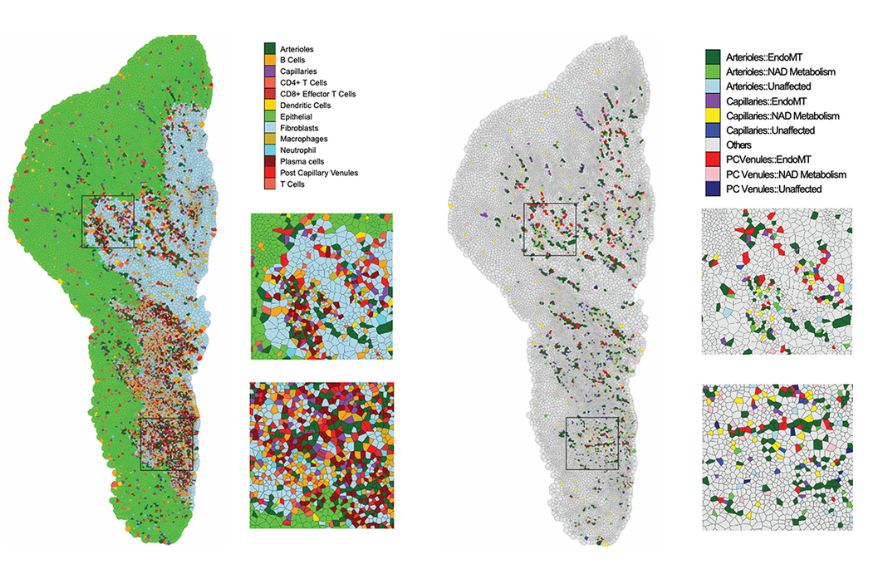
The key similarity they found was that CD38, a protein associated with inflammation, aging and cellular metabolism, was enriched in blood vessel cells in cases of rapidly progressing periodontitis and peri-implantitis.
By using spatial biology to compare these related diseases directly in human tissue, the team was able to identify a shared blood vessel pattern that may represent a drug-targetable mechanism of rapid tissue destruction.
“This hasn’t been described before in peri-implantitis,” said Easter, research scientist at the VCU School of Dentistry. “This is a new mechanism that could potentially change the way that this disease is thought about or even treated.”
Implications for cancer and other diseases
Like cancer, periodontal disease is incredibly prevalent, and both benefit from research that explains why some diseases progress slowly while others become aggressive. Many cases of peri-implantitis can progress rapidly, causing tissue and bone breakdown that may ultimately lead to implant failure.
“In the rapidly advancing subset, it suggests that there are subtypes and different disease mechanisms that show up,” said Byrd. “There are some cancers that also progress very quickly. With Massey’s support, we are now asking whether similar changes in blood vessel structure may help explain aggressive behavior in other diseases, including cancer.”
To better understand these disease mechanisms, the team aims to identify biological pathways that could eventually be targeted to slow rapid disease progression.
“If we apply this approach to cancer, we may find that very different tumors share the same vascular or fibroblast patterns,” said Liu, director of Bioinformatics Shared Resource at Massey and professor in the Department of Cellular, Molecular and Genetic Medicine at the VCU School of Medicine. “Those shared patterns could reveal common therapeutic targets, while the computational tools developed here will help build the foundation for future cancer studies and advanced spatial medicine at Massey and beyond.”
Moving forward, the team plans to continue building single-cell and spatial atlases across more than 20 human diseases, including oral inflammatory diseases and cancer. By integrating these datasets, researchers aim to identify shared disease patterns, uncover potential therapeutic targets and support more precise approaches to treatment.
“We’re moving beyond studying one disease at a time,” said Byrd. “By building and integrating single-cell and spatial atlases across many human diseases, we can identify shared mechanisms of disease progression and potentially uncover new targets for treatment.”
Collaborators
- Additional VCU collaborators: Bruno F. Matuck
- The study was conducted through an international collaboration of researchers from the United States, Brazil and Japan, bringing together expertise in periodontology, microbiology, computational biology, single-cell genomics and spatial biology. Collaborating institutions included the University of Campinas, the University of North Carolina at Chapel Hill, Nihon University School of Dentistry, the University of Pennsylvania, the University of California, San Francisco, and the University at Buffalo.
This research was funded in part by:
- VCU Department of Oral and Craniofacial Molecular Biology
- VCU Massey Comprehensive Cancer Center’s NIH-NCI Cancer Center Support Grant
- VCU Wright Regional Center for Clinical and Translational Science
- American Academy of Implant Dentistry Foundation
- Penn School of Dental Medicine, Department of Oral and Maxillofacial Surgery
- ADA Science and Research Institute
- Chan Zuckerberg Initiative
- Fundação de Amparo à Pesquisa do Estado de São Paulo (FAPESP)
- National Institute of Dental and Craniofacial Research (NIDCR)
- Nihon University
Written by: Tatiana Del Valle
Related News
Research & Innovation
Simulating cellular environments to fight advanced prostate cancerOct 7, 2026
Research & Innovation
VCU Massey researchers receive $2.5M NIH grant to inform breast, pancreatic cancer careSep 9, 2026

Get access to new, innovative care
Treatments in clinical trials may be more effective or have fewer side effects than the treatments that are currently available. With more than 200 studies for multiple types of cancers and cancer prevention, Massey supports a wide array of clinical trials.

Find a provider
Massey supports hundreds of top cancer specialists serving the needs of our patients. Massey’s medical team provides a wealth of expertise in cancer diagnosis, treatment, prevention and symptom management.