Latest News
Community Engagement, Prevention , Leadership
‘The promise of cancer science should belong to everyone’ Baskin, Massey leaders drive cancer disparities research forward at AACR conference
Oct 21, 2026
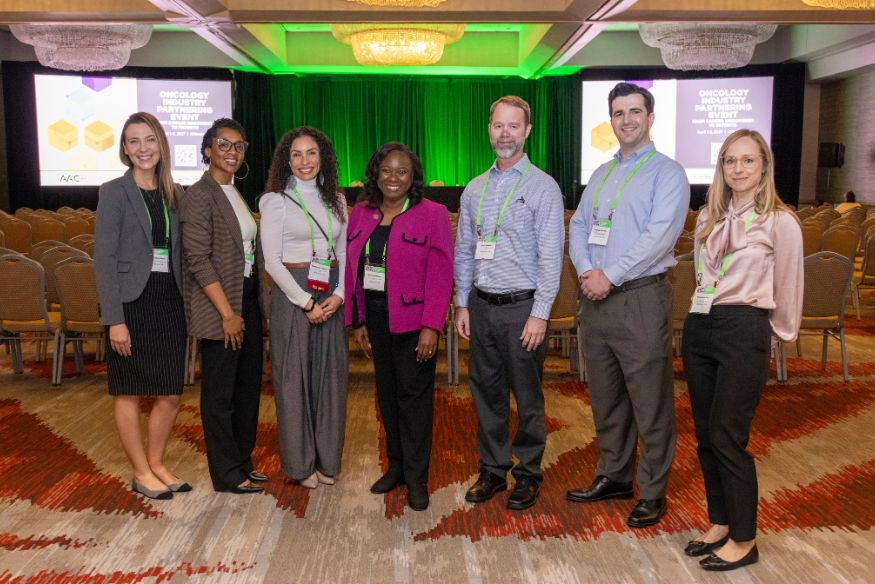 Massey leaders showcased their expertise at the AACR Conference on the Science of Cancer Health Disparities.
ATLANTA – Leaders from VCU Massey Comprehensive Cancer Center were among the experts who presented at the 19th annual American Association for Cancer Research (AACR) Conference on the Science of Cancer Health Disparities, Oct. 18-21, at the Hilton Atlanta.
Baskin delivers keynote address in hometown of Atlanta
Monica L. Baskin, Ph.D., FSBM, FABMR, director and Jeanette and Eric Lipman Chair in Oncology and senior associate dean for cancer innovation in the VCU School of Medicine, delivered the keynote address to open the conference, which took place in her home town of Atlanta. Baskin reflected on her experiences in Atlanta and how growing up around leaders like the former U.S. Congressman John Lewis, civil rights leaders Rev. Hosea Williams and Vivian Malone Jones, and former Atlanta mayors Maynard Jackson Jr. and Andrew Young sparked her passion for community engagement and access to care.
“I grew up in a space where I saw a number of people who are leaders in the community,” Baskin reflected. “Yes, they also happen to be some of the names that most of us will remember from the Civil Rights movement. But these were people that were just the parents of my friends and colleagues, or they were teachers at my school.
“They really instilled that civic engagement is critical. How we can use policies, economic policies, to try to address some of the disparities that exist, and that was really important. The main thing I learned was leadership. I learned to stop waiting for somebody else to make a difference and do something and really step up and lead.”
Talking about her work and her mission as a renowned population scientist, Baskin said, “Cancer disparities are not inevitable. They are the predictable consequence of social, structural and healthcare barriers and therefore they are solvable.
“The future of cancer care depends not only on scientific breakthroughs, but on ensuring those breakthroughs reach everyone because the promise of cancer science should belong to everyone.”
Tatum heads discussion on GLP-1 usage in cancer risk reduction
On Monday, Kristina L. Tatum, PsyD, MS, the lead author on a study that highlighted the potential connection between GLP-1 usage and a reduced risk of breast cancer, and an instructor in the Department of Social and Behavioral Sciences at the VCU School of Public Health, presented during a plenary session discussing the promises held by GLP-1s in the reduction of cancer risk.
During her presentation, Tatum, a former postdoctoral scholar at Massey, remarked, “We are seeing a signal between GLP-1 and breast cancer outcomes, although it's not clear what that signal is. We are definitely seeing improvements in survival and improvements and recurrence. We are unsure of what is driving those outcomes, but what we are sure of is that there have been some improvements in benefits.”
As GLP-1s help health outcomes in people afflicted with obesity or diabetes, Tatum said it was only natural to see if GLP-1s had a correlation in breast cancer survival, especially since individuals with breast cancer and chronic conditions like obesity and type two diabetes are more susceptible to worse outcomes. “Being able to find some type of medication that improves breast cancer outcomes, I think it's quite exciting.”
Still, Tatum cautioned that the research into the link between a reduction in breast cancer risk and GLP-1 usage was in its early stages. “However, we are definitely cautious because a lot of the work has been done specifically in observational studies, in retrospective studies, and we really need a need those prospective studies and randomized clinical trial to move the work forward and to just have more trust within the scientific community to pinning on the benefits that we see with some of the clinical trials.”
Trevino and Harrell highlight models for cancer health disparities research
Tuesday afternoon brought an opportunity for two Massey researchers to showcase their collaboration around cancer health disparities research. Jose Trevino, M.D., surgeon-in-chief, member of the Developmental Therapeutics research program and Geoffrey R. Shudtz Chair in Pancreatic Cancer Research at Massey chaired the panel, while Chuck Harrell, Ph.D., a member of the Cancer Biology research program at Massey presented during the educational session.
Trevino spoke on the importance and impact of these models and the need to expand models to represent a more diverse patient population. He spoke to why Massey is one of the leaders in this space, saying, “One of the key components of Richmond, Virginia, and Massey Comprehensive Cancer Center is that we serve an incredibly diverse patient population. Our catchment area represents what the United States looks like.
“And the reason I think that's important is because at the end of the day, this type of research again represents our country. And so while cancer health disparities research often focuses in particular areas, in particular patient populations, if you really think about this, we are really researching and treating cancers for all as a representation of the United States.”
During his presentation, Harrell highlighted the need to increase the genetic diversity of model systems so that they better represent our patient populations. Harrell spoke to an NCI-funded program on which he and Trevino are co-leaders that allow them to develop patient-derived xenografts.
“When a patient gets diagnosed with cancer, that tumor gets taken out. And the part you need is used for diagnosis. And then the rest of it gets thrown away.
“But if a patient donates the remainder to research, we are able to take it while it's still fresh and viable and expand it for use in the lab. And so what we're funded to do by the NCI and the center to reduce health disparities is to make models that represent all people, because a lot of the cell lines that people have traditionally used for the past 50 years are only representative of European ancestry populations.
“And so now we're able to make models representing people of African or Asian ancestries. And they compare not only the genetic differences, but also which therapeutics may work better or worse for different populations.”
Tossas leads plenary session on the socio-microbiome
On the final day of the conference, Katherine Y. Tossas, Ph.D., MS, director of catchment area data analytics (CADA) and a member of the Cancer Prevention and Control research program at Massey, chaired a plenary session that explored the socio-microbiome in cancer health disparities research.
A field of continued emphasis, the socio-microbiome connects structural social inequalities like socioeconomic status, the environment in which a person lives, and racial disparities, to changes in the human microbiome that can affect cancer outcomes.
Tossas encouraged attendees to consider how social conditions impact microbiomes and remember that the science is ready to meet the urgency that exists in communities that carry a heavy cancer burden.
She noted, “Importantly, we cannot talk just about the human microbiome. We know that our experiences can change our biology. the microbiome is a vehicle through which our experiences can embed.”
The AACR Conference on the Science of Cancer Health Disparities brought together an international group of experts in access to quality cancer care, treatment, and survivorship, with the aim of the conference to advance the understanding of cancer health disparities that pose significant public health challenges and disproportionately affect vulnerable communities.
Internationally renowned for its community-to-bench model, Massey is considered a leader in addressing health disparities and utilizing its population to drive research and treatment focuses.
Photos from the event can be found here.
Related News
Research & Innovation, Prevention
VCU Massey Comprehensive Cancer Center researchers showcase new mechanism to target glucosylceramide synthase in cancer therapyNov 9, 2026
Research & Innovation, Community Engagement
Massey fellow studies pancreatic cancer and brings science to the communityNov 4, 2026
Clinical Care, Prevention
Understanding breast cancer - Screening, treatment and advocacyOct 27, 2026

Get access to new, innovative care
Treatments in clinical trials may be more effective or have fewer side effects than the treatments that are currently available. With more than 200 studies for multiple types of cancers and cancer prevention, Massey supports a wide array of clinical trials.
Find a provider
Massey supports hundreds of top cancer specialists serving the needs of our patients. Massey’s medical team provides a wealth of expertise in cancer diagnosis, treatment, prevention and symptom management.