
Latest News
First-of-its-kind research receives funding to unlock molecular secrets
Nov 19, 2020
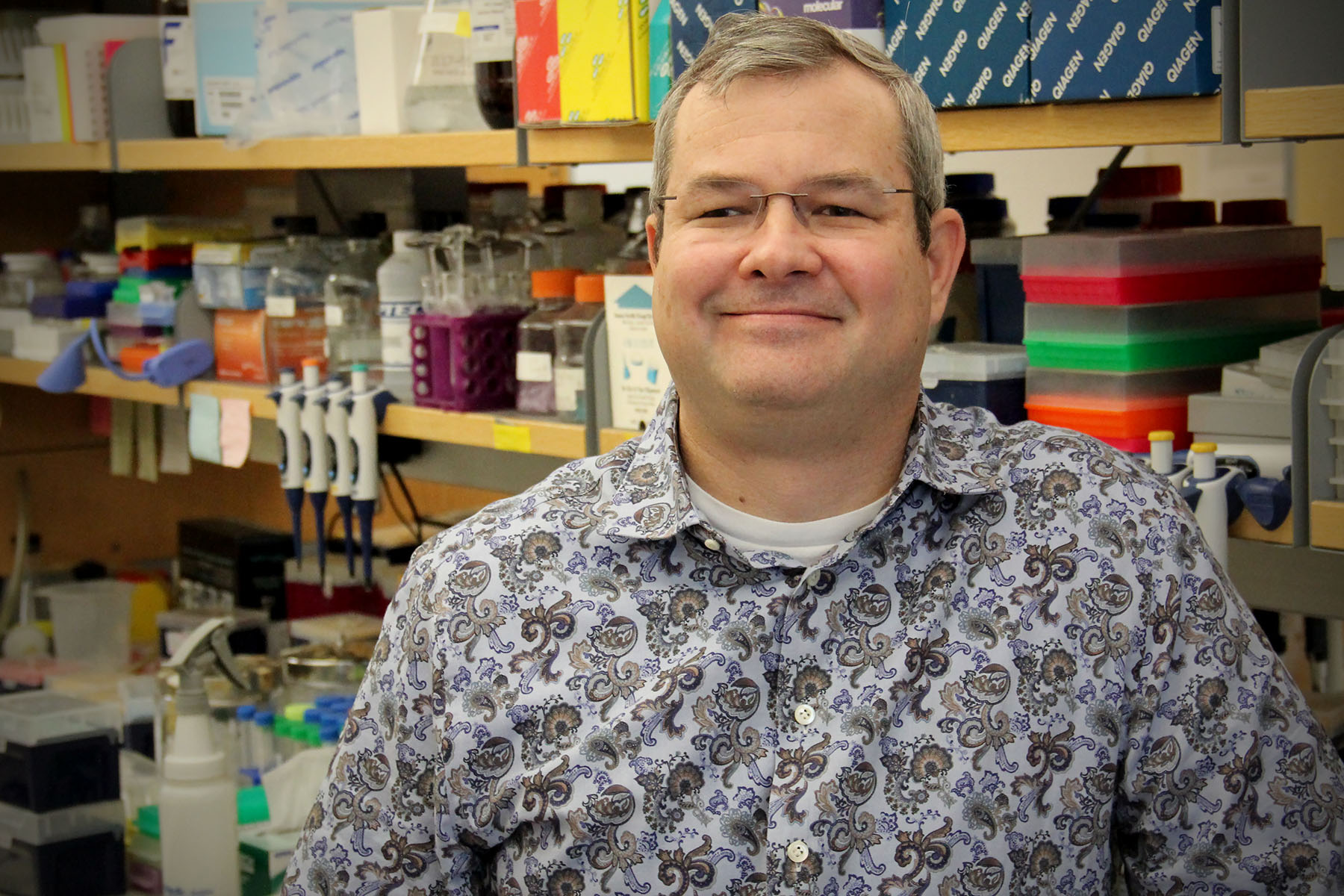
VCU Massey Cancer Center researcher John Hackett, Ph.D., is at the forefront of integrating computer simulations with laboratory experiments to understand complex biological systems at the molecular level. His work has tremendous implications for the development of drugs to treat a range of diseases and is so significant that the National Institutes of Health has funded his team for more than a decade. Earlier this year, Hackett received a four-year, $1.5 million R01 grant from the National Institute of General Medical Sciences (NIGMS) to unlock the secrets of cytochromes P450 (CYPs).
CYPs are a family of enzymes essential to the metabolism of a variety of molecules. They are key players in several endocrine disorders, enhance the cancer-causing potential of environmental chemicals and mediate the adverse effects of a majority of prescription drugs.
“We know a lot about the structure of these enzymes. However, next to nothing is known about how they interact with the membranes that dictate their function,” says Hackett, a member of the Developmental Therapeutics research program at Massey and associate professor in the Department of Physiology and Biophysics in the VCU School of Medicine. “We are embarking on the first comprehensive study of how a critically important CYP behaves when interacting with actual biological membranes.”
Cells and the components inside are all enclosed in membranes, which control their interactions with other molecules. In 2019, a Value and Efficiency in Teaching and Research (VETAR) award from the VCU School of Medicine allowed Hackett to conduct pilot studies on how CYPs interact with biological membranes. This research provided the data his team needed to obtain NIGMS funding for more complex experiments.
This year, Hackett and his colleagues have published several manuscripts detailing previously unknown findings on CYPs. In May, they published a study in the Journal of Inorganic Biochemistry illustrating how the CYP aromatase binds substrates and natural products. Aromatase is an enzyme involved in the conversion of the hormone androgen to estrogen, which makes it a target for the treatment of breast cancers driven by estrogen. In August, a study published in the journal Biochemistry that was conducted with collaborators at the University of Washington illuminated how aromatase harvests androgens directly from membranes. These findings are relevant to cancers and other diseases driven by hormone production.
Hackett’s laboratory is now conducting computer simulations to determine how CYPs discriminate and harvest specific molecules directly from membranes in cells. To complement and validate their models, powerful x-ray and neutron scattering measurements will determine the exact orientation and interaction of CYPs in different membrane environments.
“We hope that our findings will open the door to new strategies for the design of drugs to treat endocrine disorders as well as breast and gynecologic cancers,” says Hackett. “We are working to refine our techniques and to extend them to understand the structures and interactions of other membrane-associated targets, which could have implications for a wide variety of diseases.”
Written by: John Wallace
Related News
Research & Innovation
Genetic code deploys cancer mafia, new targeted drug gives them an offer they can’t refuseSep 3, 2025
Community Engagement
Students Caring About Cancer (SCAC ) at VCU collaborates with Massey to build community and pursue advocacy effortFeb 27, 2025

Get access to new, innovative care
Treatments in clinical trials may be more effective or have fewer side effects than the treatments that are currently available. With more than 200 studies for multiple types of cancers and cancer prevention, Massey supports a wide array of clinical trials.

Find a provider
Massey supports hundreds of top cancer specialists serving the needs of our patients. Massey’s medical team provides a wealth of expertise in cancer diagnosis, treatment, prevention and symptom management.