Latest News
Research & Innovation, Community Engagement
Ginder Symposium showcases how the epigenetic blueprint of cancer is being created and utilized to improve treatment
Apr 14, 2026
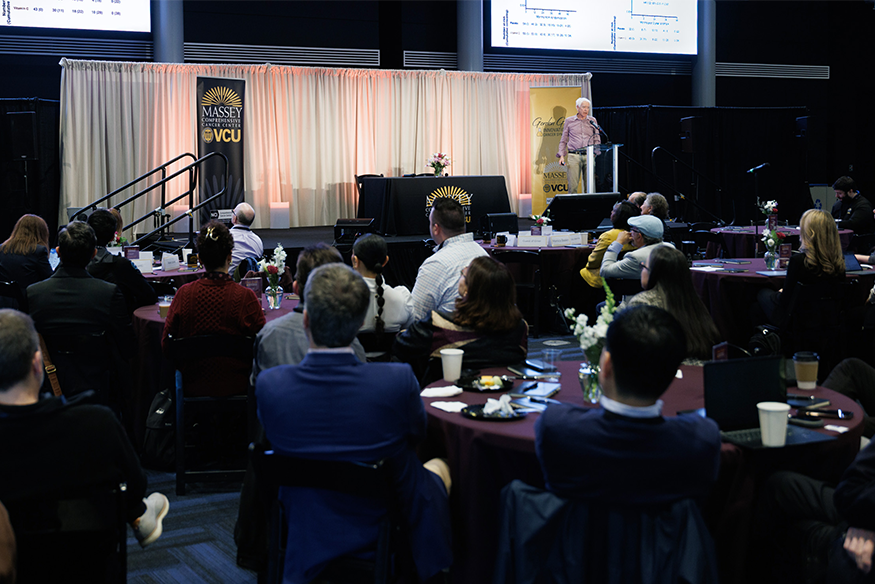 Peter Jones, Ph.D., spoke to a crowd of hundreds at VCU Massey Comprehensive Cancer Center’s 2026 Gordon Ginder Innovations in Cancer Symposium on April 9.
Hundreds gathered for VCU Massey Comprehensive Cancer Center’s 2026 Gordon Ginder Innovations in Cancer Symposium at the Dewey Gottwald Center in Richmond on April 9. This year’s conference was focused on how epigenetics, the study of how behaviors and environmental factors, such as diet, stress, exercise and toxins, cause changes that affect how genes work and how understanding those changes can benefit oncology care.
Now in its fifth year, the symposium annually brings together researchers and providers from across the country to focus on a topic that is at the forefront of pioneering cancer research and care.
Gordon Ginder’s lasting legacy
The symposium is named in honor of Gordon D. Ginder, M.D., who held the Lipman Chair in Oncology and served as director at Massey from 1997 to 2019. As one of the longest-standing NCI-designated cancer center directors, Ginder left a lasting legacy that has impacted countless lives within and beyond the Massey community. Ginder continues to contribute to research, patient care and education at Massey, where his laboratory focuses on epigenetics and regulation of genes in cancer and blood diseases.
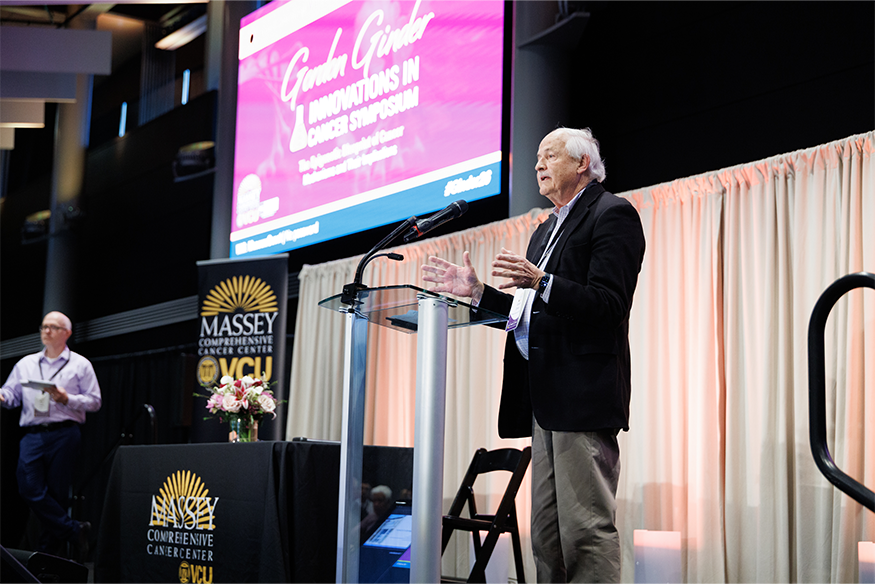 Gordon D. Ginder, M.D., served as director at Massey from 1997 to 2019.
Massey director and Lipman Chair in Oncology Robert A. Winn, M.D., said that Ginder was responsible for seminal findings in the field of epigenetics that propel the current trajectory of cancer research, and that he is a model scientist for his peers and future generations.
“I’ve learned from you the power of how being a really good person and dedicated scientist makes all the difference in the people around you,” Winn said. “When I say ‘one team, one fight’ it’s been inspired by all the people in this room.”
In opening remarks at the conference, Ginder nodded to the caliber of science and speakers that would take center stage throughout the day, but recognized that the ultimate purpose of the research and these gatherings should always be in service of the people affected by cancer.
“The end result after a long and winding road is to reach our patients and to make their lives better,” Ginder said.
Experts in epigenetics
“You would normally have to go to Switzerland to find this lineup of speakers.” - Joe Landry, Ph.D., member of the Cancer Biology research program at VCU Massey Comprehensive Cancer Center and associate professor of Human and Molecular Genetics at the VCU School of Medicine
Krista Dalton, Ph.D., a postdoctoral researcher at the Philips Institute for Oral Health Research at the VCU School of Dentistry, opened the symposium by introducing the field of cancer epigenetics, and her lab’s research investigating the epigenetic changes and factors that contribute to the development of neuroblastoma, as well as potential targeted therapies that could be effective treatment options for the disease.
Peter Jones, Ph.D., chief scientific officer at the Van Andel Institute, discussed how vitamin C can be utilized alongside TETs to intercept myeloid cancers. Jones began studying the effects of vitamin C in the 1980s, as vitamin C levels are generally inadequate in patients with cancer.
His study in the 1980s found that vitamin C helped block oncogenic transformation in cells. More recently, Jones’ phase II clinical trial focused on elevating vitamin C levels in patients with cancer. In the group treated with vitamin C, their levels increased dramatically within plasma and there was increased overall survival among patients. Furthermore, the trial looked at patients without a TET2 mutation in comparison with those who had a mutation; patients with a TET2 mutation did not respond to vitamin C treatment while those with non-mutated TET2 did respond, leading to the conclusion that TET2 is required for vitamin C-induced methylation.
Shelley Berger, Ph.D., the founding and current director of the Epigenetics Institute at the University of Pennsylvania, presented on the topic of harnessing epigenetic pathways as targets for developmental diseases and cancer. Specifically, she highlighted her work investigating nuclear speckles — protein structures that are involved in the regulation of gene expression and genome organization and the development of human diseases — and gene expression patterns that could predict patient survival in kidney cancer.
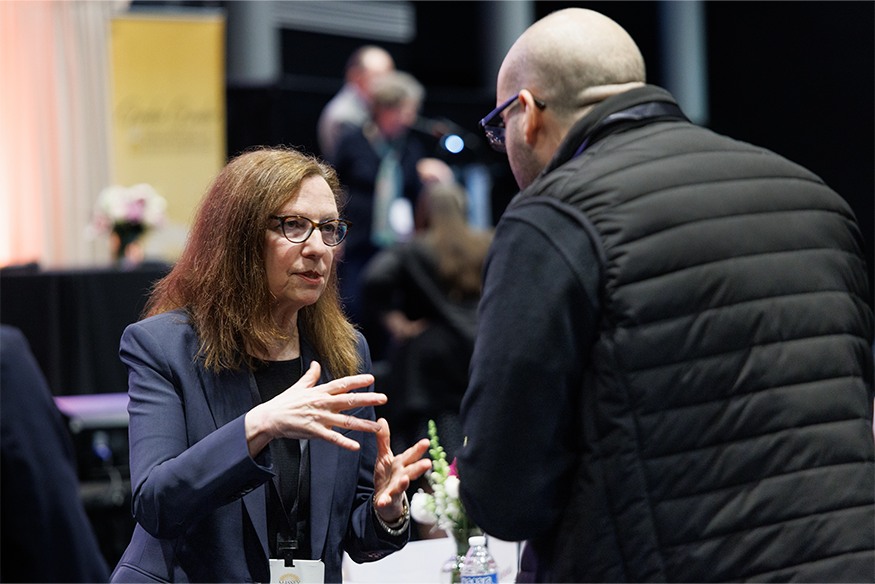 Shelley Berger, Ph.D., interacting with an attendee at VCU Massey Comprehensive Cancer Center’s 2026 Gordon Ginder Innovations in Cancer Symposium
“Nuclear speckles and DNA-speckle association are an untapped area in disease therapeutics,” Berger said.
Judy Lieberman, M.D., Ph.D., professor of pediatrics and endowed chair of cellular and molecular medicine at Harvard University, discussed how a better understanding of how tumors escape immune control can help reverse tumor editing to reignite immune responses to “cold” tumors.
Lieberman demonstrated how cell composition changes dramatically over the course of a tumor’s life cycle, becoming more protective as they evolve and evading immune recognition. In genetically-engineered mouse models, Lieberman’s lab was able to inhibit DNA methylation via decitabine, which reversed tumor editing and restored immune control of the tumor.
Harry Bear, M.D., Ph.D., surgical oncologist and member of the Developmental Therapeutics research program at Massey, discussed the relationship between immune response and outcomes in breast cancer. He presented his extensive research looking at how a class of drugs known as DNA methyltransferase inhibitors (DNMTi) can alter the tumor microenvironment and make cancers respond better to existing cancer therapies.
His work has been published in The New England Journal of Medicine and shaped a new standard of care for early-stage triple-negative breast cancer, and his research team is currently working to initiate a clinical trial examining the efficacy of combining DNMTi with dual immune checkpoint blockades to treat advanced triple-negative breast cancer.
Following a lunch break, Cathrine Hoyo, Ph.D., the Goodnight Innovation Distinguished Chair at North Carolina State University, presented her lab’s findings that demonstrate how impact control centers (ICRs) in genes can serve as markers for early detection of severe liver disease in adults. In using an ICR-based fingerprint, her lab used 23 different ICRs to link early childhood obesity to adult liver cancer and cirrhosis.
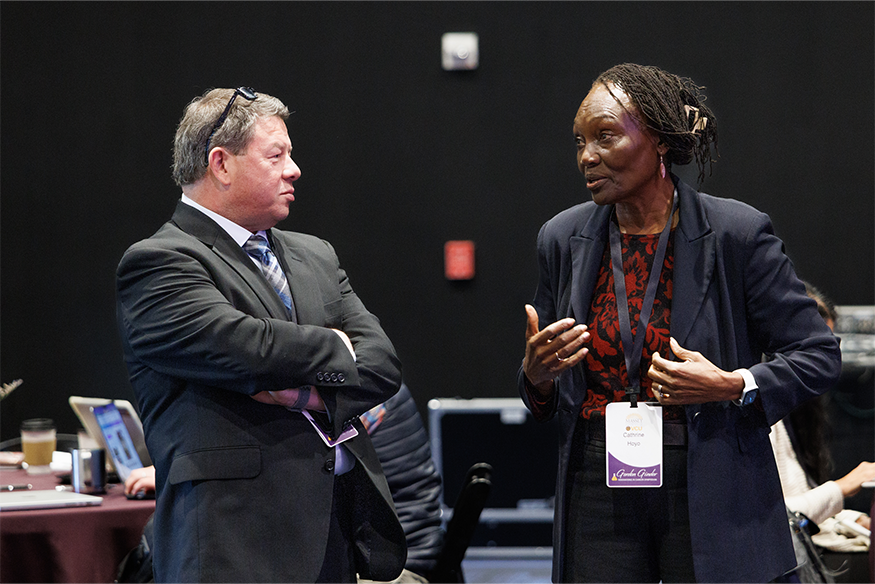 Catherine Hoyo, Ph.D., speaking with Bernard Fuemmeler, Ph.D., MPH
Her lab also showed how epigenetic links exist between environmental factors and metabolic and liver dysfunction. By studying cadmium and lead levels in the Durham, N.C., area, she demonstrated that chronic disease susceptibility may be detectable on the epigenome.
From bench to bedside: How cancer research comes full circle
The science presented during this year’s symposium serves as the foundation for new discoveries and treatments that are translated into patients through clinical trials. In the afternoon, Keri Maher, DO, the medical director of the Clinical Trials Office at Massey, moderated a panel discussion featuring two leukemia survivors who are in full remission after participating in clinical trials at Massey.
Elner Capati, who was diagnosed with acute myeloid leukemia in January 2025, said that participating in a clinical trial was the next logical step after other treatments failed to work.
“I wouldn’t be here unless someone else volunteered for one of these trials [before me],” Capati said. “For me, [it was about] not giving up hope, trusting in the doctors and the medicine. I wouldn’t have made it this far without the hard work that everyone put in.”
Christine Patafio, whose myelodysplastic syndrome progressed into leukemia in 2025, expressed immense gratitude for her care team and the clinical trial that helped her be able to celebrate her 43rd wedding anniversary this week.
“I felt 100% supported at VCU. If that’s the norm [everywhere], I’m surprised,” Patafio said. “I felt I was in a very special place. Kindness goes a long way, even when you’re very sick. It was universal at VCU.”
Written by: Bill Potter, Blake Belden
Related News
Research & Innovation, Clinical Care, Prevention , Leadership
International community gathers for 2026 Global Cardio-Oncology Summit in WilliamsburgOct 14, 2026
Research & Innovation
Simulating cellular environments to fight advanced prostate cancerOct 7, 2026

Get access to new, innovative care
Treatments in clinical trials may be more effective or have fewer side effects than the treatments that are currently available. With more than 200 studies for multiple types of cancers and cancer prevention, Massey supports a wide array of clinical trials.

Find a provider
Massey supports hundreds of top cancer specialists serving the needs of our patients. Massey’s medical team provides a wealth of expertise in cancer diagnosis, treatment, prevention and symptom management.