Latest News
Research & Innovation
National Cancer Research Month: Each discovery adds a little piece to the puzzle
May 29, 2026
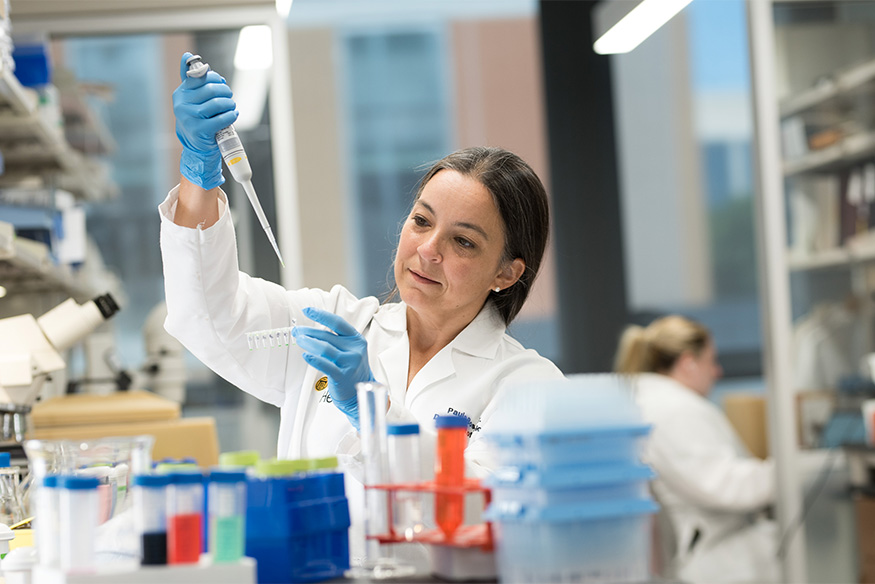 Paula Bos, Ph.D.
More than 18 million people in the U.S. are living with, through and beyond their cancer, according to the American Association for Cancer Research. This is largely thanks to the continual cutting-edge advancements made in the field of cancer research.
Paula D. Bos, Ph.D., the leader of the Cancer Biology research program at VCU Massey Comprehensive Cancer Center, still remembers the first biology class in college that shaped her entire career, in which the students debated the properties of life, as well as whether a virus is truly alive. Bos became fascinated by the concept of viral oncogenesis, the process through which viruses enter cells and take over their functions, replicate into a new form and cause cancer.
This curiosity snowballed into her master’s degree efforts in Argentina, where she investigated the human papillomavirus and cervical cancer disparities among indigenous populations in South America.
“I’m drawn to the ability to provide a piece of the puzzle that can help impact a patient’s life,” Bos said. “If you can contribute just a little piece of that puzzle, then you are improving someone’s life, and you can hopefully fix one part of the larger problem of cancer.”
For National Cancer Research Month, we spoke with Bos about her career, the critical role of funding in the discovery of new medical breakthroughs, the future of cancer science, and more.
When did you start working at Massey?
I began working at Massey in late 2015, and I love the collegiality of it all here. People are open about their research ideas, and collaboration happens very naturally. Everyone is willing to work together, which is vital because science now is entirely about collaboration. The days of conducting science on our own are pretty much gone.
What is the Cancer Biology research program at Massey?
There are three research programs at Massey: Cancer Biology, Developmental Therapeutics, and Cancer Prevention and Control. Cancer Biology drives our basic science, focusing on how the disease works at a foundational level. We study genes—where the genetic information is stored—and signaling pathways, the ‘languages’ cancer cells use to grow uncontrollably.
We also study how cancer cells exploit normal neighboring cells within the tumor microenvironment, seeking answers to questions like ‘How do genes talk to that environment?’ and ‘How do the normal cells help fuel cancer, allowing it to grow and spread to other organs?’ Answering these questions is the core mission of the Cancer Biology program.
Our discoveries then are used by clinicians to develop new clinical trials, with the hope of translating our science into effective patient therapies.
What is the primary focus of your research?
My lab focuses on brain metastases—cancer that has spread to the brain—for which there are currently no effective treatments; there is very little that doctors can do. Because cancer patients are living longer, the incidence of brain metastasis is on the rise. It used to be a late-stage event, but treatments have improved so much that patients can live with disseminated disease for a longer time. We want to understand how a cancer cell originating in the mammary gland, for example, can successfully adapt and make a home in the brain.
Specifically, our lab is interested in Treg cells—immune cells that act as the ‘police’ of the immune system—and how they regulate different signals to drive cancer. Cancer is incredibly smart; it doesn't invent new tools, but instead hijacks existing cellular pathways that normally serve a different purpose. For instance, Treg cells evolved to defend us from autoimmune diseases by dampening the immune response. Tumors recruit these Treg cells in large numbers to intentionally quiet the immune responses trying to attack the cancer. My lab is looking at how we can manipulate these cells to make the tumors sensitive to immune attack once again.
What drives you in your work every day?
What drives me every day is a deep fascination with how things work, and the knowledge that even a tiny discovery brings patients one step closer to a solution. Science is hard; big breakthroughs only happen once in a blue moon, and there are plenty of failures in between. To do this work you have to love the journey and have a true passion for discovery – when something doesn’t go your way, it should drive you to the next level. Ultimately, as we get older, cancer touches everyone in painful ways. Having lost so many people I love to this disease, finding answers is my ultimate driver.
How does science inform the latest innovations in cancer prevention and care?
When illustrating how basic science drives innovation in cancer care, I always point to immune checkpoint blockades—a breakthrough that required a 15-year journey from the lab to the clinic. These innovative immunotherapy drugs work by blocking specific proteins to unleash the body's own immune response against cancer. The very first melanoma patient treated with an anti-CTLA4 blockade in that initial clinical trial is still alive today. We are making monumental strides, but it all started in the 1980s when James P. Allison, Ph.D., looked at a T cell and simply wondered how a single surface marker functioned from a pure biological perspective. His fundamental curiosity pioneered a field that is saving lives decades later. Innovation always starts in the lab.
What are some of the latest advances in research at Massey?
As one of just two NCI-designated Comprehensive Cancer Centers in Virginia, Massey is at the forefront of the nation’s cancer research efforts. Every day, scientists are conducting cutting-edge research: investigating how a heart medication could serve as a targeted treatment option in lymphoma, examining therapeutic strategies to overcome resistance to chemotherapy in breast cancer, and exploring how an innovative drug could halt the spread of prostate cancer to the bone, among so many other scientific efforts.
Sarah Spiegel, Ph.D., a former leader and member of our program at Massey, recently published a seminal discovery that completely rewrites the fundamental biology of how S1P, a critical cellular messenger, is transported. While we previously viewed the SPNS2 transporter as a passive exit door, Dr. Spiegel's team discovered that it actually functions like a revolving door. Every time it exports an S1P molecule, it brings in a glucose molecule. By directly linking lipid signaling to glucose metabolism, this mechanism fuels essential cellular functions and opens up massive new therapeutic possibilities. This is just one example of the many research advances ongoing at Massey.
What are the benefits of conducting research at an NCI-designated Comprehensive Cancer Center?
When you have all of these complementary parts working together, that path from discovery to making a difference in a patient's life becomes much clearer. Having an NCI comprehensive designation means that we can deliver better patient care because we can efficiently translate what we discover in the lab to the bedside.
What is the importance of funding for cancer research?
Cancer research funding is the oil in the machine. Cancer research is incredibly expensive, and it is impossible to predict what baseline discoveries will become the breakthroughs of tomorrow. Sometimes investing in an unconventional or less popular idea today yields the next revolution in 25 or 30 years. This culture of funding curiosity is exactly why so many international scientists come to the U.S. to pursue their careers—in many of our home countries, the resources simply do not exist. We are living in the best possible era for scientific discovery because our technological capabilities are unprecedented, but that technology comes with a high price tag. Federal grants are, by far, the most substantial and vital fuel keeping this entire machine moving forward.
Is there anything about cancer science that you think the average person might not know?
One of the most challenging concepts to digest is that every cancer patient has an entirely different disease. We speak broadly about 'breast cancer,' for example, but each of the millions of people diagnosed with it experiences a completely individualized illness. This is what makes oncology so challenging: as scientists, we look for general rules, but cancer is a highly opportunistic disease. It adapts to the unique biology of the host—and because we are all different, cancer is different in everyone. We almost need a unique solution for every single person. It is a level of complexity that can be difficult to grasp, even for us as scientists at times.
How do you get the community more engaged in basic science?
One of the primary barriers we face today is a gap in understanding between scientists and the community, largely because we are not effective enough at communicating our work in lay terms.
Through the T32 Integrative Training in Cancer Biology program that I lead, we are actively changing this. Each of our trainees has a community mentor and is required to present their laboratory research to our community advocates, the Massey Cancer Champions. They must find creative metaphors and accessible language to clearly explain their work. After all, if people don't know what we are doing, how can they understand its importance? Bridging that communication gap is something we as scientists must do better.
What does the future of cancer research look like to you?
When looking at the future of cancer science, I see two major frontiers.
First, a primary goal of next-generation research must be finding new ways to fuel immune cells so they can effectively dismantle tumors. The immune system is incredibly smart and evolves uniquely within each individual; our mission now is to discover more ways to harness that native power. That is precisely why immunotherapy is the most exciting horizon in oncology.
Second, we must bridge a critical gap in our understanding: how the macro-environment—the external, real-world factors a person experiences—helps drive or suppress cancer. Unlocking that connection between the external environment and cellular biology is truly the next frontier.
Written by: Blake Belden
Related News
Research & Innovation
Depression and stress drive long-term fatigue for breast cancer survivorsSep 3, 2026
Research & Innovation, Clinical Care
A patient guide to cardio-oncology: Cancer care and heart healthAug 19, 2026

Get access to new, innovative care
Treatments in clinical trials may be more effective or have fewer side effects than the treatments that are currently available. With more than 200 studies for multiple types of cancers and cancer prevention, Massey supports a wide array of clinical trials.
Find a provider
Massey supports hundreds of top cancer specialists serving the needs of our patients. Massey’s medical team provides a wealth of expertise in cancer diagnosis, treatment, prevention and symptom management.