
Latest News
Research & Innovation
January-March 2026: Published research at Massey
Apr 21, 2026
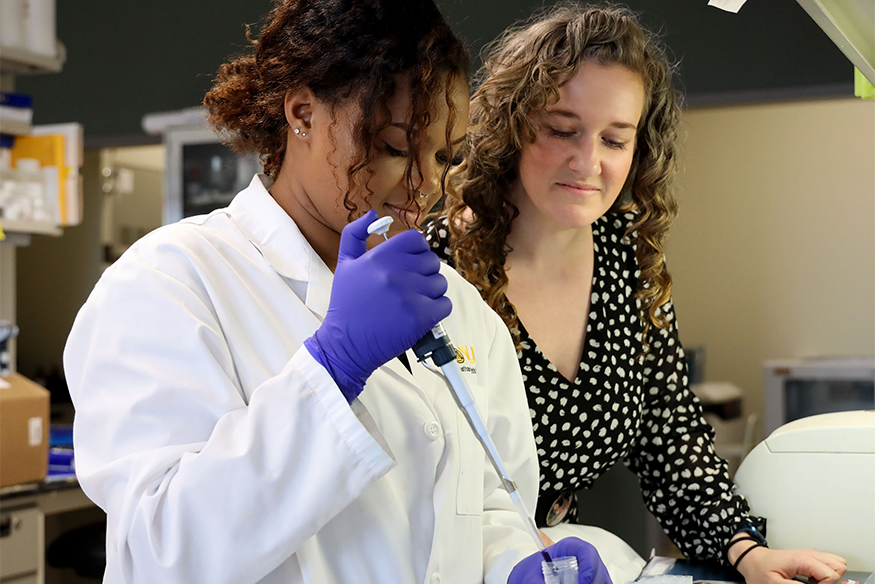 Alexis Fakunmoju, M.S., VCU School of Dentistry alum, in the laboratory with Molly Bristol, Ph.D., member of the Cancer Biology research program at VCU Massey Comprehensive Cancer Center. (Credit: John Wallace)
As one of just two NCI-designated Comprehensive Cancer Centers in Virginia, VCU Massey Comprehensive Cancer Center is at the forefront of the nation’s cancer research efforts. Scientists at Massey conduct cutting-edge, laboratory-based basic, population, and clinical and translational-focused research to advance improved approaches to prevent, diagnose and treat cancer. Continue reading to learn more about publications from Massey researchers in January, February and March 2026.
PUBLISHED RESEARCH
Understanding why endocrine therapy causes musculoskeletal issues in breast cancer
Massey research members: M. Imad Damaj, Ph.D., and Hamid Akbarali, Ph.D.
Journal: British Pharmacological Society
Publication date: Jan. 2, 2026
Breast cancer usually presents as estrogen-receptor positive in post-menopausal women. A class of drugs known as aromatase inhibitors are the most effective standard endocrine therapy, however, patients often experience musculoskeletal side effects. A team of Massey scientists developed preclinical models to better understand the cellular biology responsible for this common toxicity that occurs in a large population of breast cancer patients.
VCU collaborators: Isis Betancourt-Toscano, Naiara Johnson Diaz, Sara M. Herz, Dawn Jessup, Ph.D., Abrar Khan, Eda Koseli, DVM, Bryan McKiver, Ph.D., Justin L. Poklis, Jane Roberts, Gabriella M. Silva, Ph.D., and Esad Ulker, M.D.
How a heart medication could unlock a new targeted approach in lymphoma
Massey research member: Ronald Gartenhaus, M.D.
Journal: Pharmacological Research
Publication date: Jan. 6, 2026
A team of Massey researchers have discovered an innovative way to use a drug already approved in treating irregular heartbeat to selectively target specific functions of enzymes in lymphoma, effectively killing cancer cells and reducing tumor growth with little to no toxicity. Recent findings set the groundwork for how this strategy could help transform the future of precision medicine in cancer.
VCU collaborators: Bandish Kapadia, Ph.D., Noah Herrington, Ph.D., Forum Kayastha, Ph.D., Glen E. Kellogg, Ph.D., and Anirban Roychowdhury, Ph.D.
Shared resources reduce costs and barriers for researchers
Massey research members: Rebecca Martin, Ph.D., Hamid I. Akbarali, Ph.D., Swadesh K. Das, Ph.D., Victoria J. Findlay, Ph.D., Paul B. Fisher, Ph.D., Joseph Landry, Ph.D., Alexander Neuwelt, M.D., Sandro R.P. da Rocha, Ph.D., Devanand Sarkar, Ph.D., and Xiang-Yang Wang, Ph.D.
Journal: Frontiers in Immunology
Publication date: Jan. 8, 2026
With the advancement of spectral cytometry, high-dimensional flow analysis has become increasingly accessible for cancer researchers. However, this introduces greater complexities across different areas, so flow cytometry shared resources can play a critical role in bridging this gap for new users. This paper describes how shared resource facilities can reduce costs, increase reproducibility and lower the barriers of entry for researchers into the field of high parameter spectral flow cytometry.
VCU collaborators: Madison G. Isbell, M.S., Maria Garcia Bonilla, Stanley Cheatham, Ph.D., Matthew E. Fernandez, Ph.D., Bradley Krisanits, Ph.D., Amit Kumar, Ph.D., David D. Limbrick, Jr., M.D., Padmanabhan Mannangatti, Ph.D., Lauren May, Rachel G. Mendoza, Marie Michenkova, Thuy-An Nguyen, Xinyan Pei, M.D., Kirill Shumilov, Ph.D., Douglas H. Sweet, Ph.D., and Alex Wendling, M.S.
Multiple primary cancer incidence by county-level smoking prevalence among U.S. cancer survivors
Massey research members: Katherine Tossas, Ph.D., M.S., Susan Hong, M.D., Oxana Palesh, M.D., Ph.D., Robert A. Winn, M.D., and Renato Martins, M.D.
Journal: Cancer Epidemiology, Biomarkers & Prevention
Publication date: Jan. 9, 2026
As the number of cancer survivors in the United States grows, multiple primary cancer (MPC)—the development of two or more primary cancers—has become an increasing public health concern. Understanding geographic variation in MPC incidence can inform targeted public health strategies. In this study, Massey team members examined associations between MPC incidence and county-level cigarette smoking prevalence.
VCU collaborator: Hui Cheng, Ph.D.
HPV discovery could uncover new target for antiviral intervention
Massey research members: Claire James, Ph.D., and Iain Morgan, Ph.D.
Journal: mBio
Publication date: Jan. 12, 2026
Human papillomavirus 16 (HPV16) is known to directly influence the development of oropharyngeal, cervical and anogenital cancers. These findings expand the understanding of how HPV16 coordinates viral replication with host chromatin and DNA repair networks, uncovering a new potential target for antiviral intervention.
VCU collaborators: Phoebe Bridy, Molly L. Bristol, Ph.D., Sarita Giri, Elinor Lu, Charles Lyons, Apurva T. Prabhakar, M.S., Ph.D., Arjun Rijal, M.S., Jenny D. Roe, Xu Wang, Austin Witt and Aya Youssef
Advancing translational cervical cancer research through biobanking
Massey research members: Katherine Tossas, Ph.D., M.S., and L. Ashley Cowart, Ph.D.
Journal: Cancer Epidemiology, Biomarkers and Prevention
Publication date: Jan. 23, 2026
As cervical cancer remains a major global health concern, a team of researchers established the VCU Cervical Cytology Biorepository to support research on cervical cancer risk, molecular biomarkers and gynecologic health disparities. By implementing standardized protocols for recovery, processing, and long-term storage of residual ThinPrep Pap specimens, the team supports molecular epidemiology studies aimed at identifying biomarkers, understanding cervical cancer progression and addressing reproductive health disparities.
VCU collaborators: Bahira Ahmed, Sadia Sayeed, M.D., Guleer Shahab, M.P.H., Bianca Owens, Ph.D., Myrna Serrano, Ph.D., Gregory Buck, Ph.D., Katherine Spaine, Laahirie Edupuganti, Ciara Rhodes, Ph.D.
Researchers identify Achilles’ heel in lung cancer through common p53 genetic mutation
Massey research member: Swati Palit Deb, Ph.D.
Journal: Cell Death & Differentiation
Publication date: Jan. 26, 2026
A team of researchers at Massey has identified a new pathway through which mutations in the tumor suppressor p53 gene—found very frequently in human tumors—hijack DNA replication in cancer cells. New findings support an innovative framework for how targeting this new pathway could help to stop the replication of lung tumor cells and thwart tumor growth.
VCU collaborators: Shilpa Singh, Ph.D., Sumitra Deb, Ph.D., Rebecca Frum, Ph.D., Lilia Gheghiani, Ph.D., Brandon Velasco and Brad Windle, Ph.D.
Patient, community and clinician beliefs about multi-cancer detection tests
Massey research members: Alex H. Krist, M.D., MPH, Bernard F. Fuemmeler, Ph.D., MPH, Carrie A. Miller, Ph.D., Patrick Nana-Sinkam, M.D., and Scott M. Strayer, M.D., MPH
Journal: Journal of Public Health
Publication date: Jan. 30, 2026
Multi-cancer detection tests (MCDs) have the potential to reduce deaths by identifying cancers early when they can be more effectively treated. While initial studies show promise in detecting multiple cancer types, there is a lack of large-scale, prospective trials evaluating their clinical utility and real-world impact. Patients and clinicians want better evidence before routine use of MCD testing for cancer screening. To increase this evidence, future research should prioritize rigorous randomized controlled trials that evaluate cancer-mortality, quality of life, diagnostic workup and potential harms.
VCU collaborators: E. Marshall Brooks, Ph.D., Rebecca Alemu, Kendra Rowe and Gabriela Villalobos, MSW
Therapeutic synergies that overcome carboplatin resistance in triple-negative breast cancer
Massey research members: J. Chuck Harrell, Ph.D., and Mikhail G. Dozmorov, Ph.D.
Journal: Journal of Experimental & Clinical Cancer Research
Publication date: Feb. 3, 2026
Triple-negative breast cancer (TNBC) is an aggressive subtype lacking targeted therapeutic options, where platinum-based chemotherapy such as carboplatin serves as a cornerstone of treatment. Despite initial responses, the rapid emergence of acquired resistance remains a major clinical barrier. Researchers found that isogenic PDX models of TNBC provide a powerful platform to define molecular mechanisms of acquired carboplatin resistance and uncover actionable therapeutic strategies. Their study revealed multiple adaptive routes to platinum resistance, including restoration of homologous recombination and activation of alternative DNA repair programs.
VCU collaborators: Julia E. Altman, Ph.D., David C. Boyd, Ph.D., Nina Dashti-Gibson, Rachel K. Myrick, Amy L. Olex, Ph.D., Aaron Valentine and Emily K. Zboril
Combination strategy prevents resistance and enhances efficacy in pancreatic cancer
Massey research members: Said Sebti, Ph.D., and Jose Trevino, M.D.
Journal: European Journal of Cancer
Publication date: Feb. 3, 2026
The KRAS G12D inhibitor MRTX1133 represents a major advance in targeting oncogenic KRAS, but adaptive resistance driven by ERK reactivation limits its efficacy. Recent study findings establish a combination strategy, using FGTI-2734, that overcomes a significant mechanism of resistance to MRTX1133 and offer a potential treatment option for pancreatic cancers, including those resistant to current therapies.
VCU collaborators: Deblina Ghosh, Ph.D., Aslamuzzaman Kazi, Ph.D., Hitesh Vasiyani, Ph.D., and Vignesh Vudatha, M.D.
Harnessing post-traumatic growth in brain cancer patients and caregivers
Massey research members: Ashlee Loughan, Ph.D., Sarah Braun, Ph.D., and Autumn Lanoye, Ph.D.
Journal: Journal of Neuro-Oncology
Publication date: Feb. 11, 2026
Individuals with primary brain tumors and their caregivers experience substantial psychological distress, yet positive psychological outcomes, such as post-traumatic growth, remain understudied. These study findings highlight the potential for psychosocial and palliative interventions to harness post-traumatic growth through meaning-making and existential engagement among brain cancer patients and caregivers.
VCU collaborator: Max Hernand
Neighborhood factors related to financial stress are linked to worse breast cancer outcomes; interventions could improve survivorship
Massey research members: Bernard Fuemmeler, Ph.D., MPH, and Carrie Miller, Ph.D.
Journal: JAMA Network Open
Publication date: Feb. 18, 2026
New research connects multiple residential factors generally associated with financial strain, such as high housing costs and crowded households, to worse overall outcomes among breast cancer survivors. Led by investigators at Massey, the findings could help inform innovative strategies to increase health care access and ease economic stress for a variety of patients in need.
VCU collaborators: Joseph Boyle, Ph.D.
Scientists target DDI2 protein in proteasome-dependent cancers
Research member: Senthil Radhakrishnan, Ph.D.
Journal: iScience
Publication date: Feb. 18, 2026
Two cellular systems—the ubiquitin-proteasome system and the autophagy-lysosome pathway—are largely responsible for protein degradation within cells, yet the molecular mechanisms linking them remain unclear. A new study from Massey scientists reveals that a stress-responsive axis between two separate proteins—DDI2 and CCN1—modifies protein production. The findings indicate that DDI2 could be a potential therapeutic target in proteasome-dependent cancers.
VCU collaborators: Nayyerehalsadat Hosseini, Amy N. Brooks, Holly A. Byers, Ahmed M. Elshazly, Janakiram R. Vangala and Madison A. Ward
Isolation of regulatory T cells from healthy murine mammary glands
Massey research members: Paula D. Bos, Ph.D.
Journal: Methods in Cell Biology
Publication date: Feb. 20, 2026
Regulatory T cells, also known as Treg cells, are a subset of CD4+ lymphocytes that were initially studied for their immunosuppressive ability in lymphoid tissues. Increasingly, the importance of Treg cells in non-lymphoid tissues has become clear. However, the function of mammary-gland-resident Treg cells has not been well described, likely in part due to the technical difficulty of isolating (relatively rare) Treg cells from the mammary gland. For this reason, this research presents a protocol for obtaining Treg cells from mouse mammary glands, using a technique known as fluorescence-activated cell sorting.
VCU collaborators: D. Michael Mann and Hossein Ehsanbakhsh
Developing more representative models of HPV-related head and neck cancers
Massey research members: Molly L. Bristol, Ph.D., Claire D. James, Ph.D., and Iain M. Morgan, Ph.D.
Journal: mSphere
Publication date: Feb. 25, 2026
There are no effective tools for the early diagnosis of HPV-associated head and neck cancers, which continue to rise in incidence. The HPV16 subset has been detected in about 90% of these cancers. Accurate models of HPV-driven cancers are critically needed to advance translational research. This study proposes fibroblast co-culture methods as a strategy that holds significant promise for generating more representative models of HPV-associated head and neck cancers.
VCU collaborators: Austin J. Witt, Phoebe Bridy, Rachel L. Lewis, Jenny Roe and Xu Wang
Beyond blacklists: a critical assessment of exclusion set generation strategies and alternative approaches
Massey research members: Mikhail G. Dozmorov, Ph.D., Anthony C. Faber, Ph.D., and J. Chuck Harrell, Ph.D.
Journal: Bioinformatics
Publication date: March 13, 2026
Short-read sequencing data can be affected by alignment artifacts in certain genomic regions. Removing reads overlapping these exclusion regions, previously known as Blacklists, help to potentially improve biological signal. These results highlight the limitations of fixed exclusion sets, and recommend the use of specific “sponge” sequences as an alignment-guided strategy for reducing artifacts and improving functional genomics analyses.
VCU collaborators: Brydon P. G. Wall, Konstantinos V. Floros, Ph.D., Joseph L. McClay, Ph.D., My Nguyen and Jonathan D. Ogata, M.S.
Massey researchers lead international collaboration of first-ever, multi-platform digital atlas of oral tissues
Massey research members: Kevin Matthew Byrd, D.D.S., Ph.D., and Jinze Liu, Ph.D.
Journal: Cell Press Blue
Publication date: March 23, 2026
Serving as the cover story in the first-ever issue of Cell Press Blue, Massey researchers published an international study that advances the understanding of the immunoregulatory nature of human tissues, offering breakthrough insights into how fibroblasts serve as the core regulators of structural immunity in the mouth. The findings lay the groundwork for targeted modulation of fibroblast activity in fibrosis, cancer and autoimmunity.
VCU collaborators: Khoa L.A. Huynh, Bruno F. Matuck, Quinn T. Easter, Brittany T. Rupp and Xiu Yu Zhang
Massey plays key role in helping create new therapeutic standard for patients with stage III colon cancer
Massey research member: Khalid Matin, M.D.
Journal: The New England Journal of Medicine
Publication date: March 25, 2026
Massey and its NCORP affiliates played a vital role in a phase III clinical trial that has established a new therapeutic standard for patients with stage III colon cancer with deficient DNA mismatch repair. Massey participated in the ATOMIC trial, the international phase III study that evaluated adjuvant treatment strategies for this specific patient group.
Innovative targeted therapy halts prostate cancer spread to the bone
Massey research members: Paul B. Fisher, MPH, Ph.D., Swadesh K. Das, Ph.D., Jiong Li, Ph.D., and Nitai Mukhopadhyay, Ph.D.
Journal: Pharmacological Research
Publication date: March 28, 2026
New findings show that an innovative drug effectively prevents prostate tumors from spreading to an advanced and incurable stage in the bones. The targeted small molecule inhibitor, IVMT-Rx-4, also enhances standard-of-care chemotherapy treatment for the disease, offering significant potential for a paradigm shift in the treatment of metastatic tumors.
VCU collaborators: Santanu Maji, Ph.D., Maddie Gunawardena, Amit Kumar, Ph.D., Padmanabhan Mannangatti, Ph.D., Jinkal Modi, Ph.D., Rudra Pangeni, Ph.D., and Qingguo Xu, D.Phil.
Scientists identify promising target in acute myeloid leukemia
Massey research member: V. Lokesh Battula, Ph.D.
Journal: Journal of Experimental & Clinical Cancer Research
Publication date: March 28, 2026
The MERTK receptor is overexpressed in cancers, including acute myeloid leukemia (AML), and is associated with poor outcomes. This study suggests that MERTK could serve as a promising therapeutic target for treating AML. Furthermore, the findings demonstrate that a novel antibody-drug conjugate—RGX-019 MMAE—can be used as a new and effective treatment strategy for treating AML.
VCU collaborators: Anudishi Tyagi
Protein could be effective target in treatment of HPV infections
Massey research members: Claire D. James, Ph.D., Iain M. Morgan, Ph.D., and Molly L. Bristol, Ph.D.
Journal: mBio
Publication date: March 30, 2026
Human papillomavirus 16 (HPV16) is responsible for the majority of HPV-positive cancers, contributing to 54% of cervical cancers and approximately 90% of HPV-positive head and neck cancers. This study demonstrates a crucial interaction between HPV16 and the SMARCAL1 protein, suggesting that the inhibition of SMARCAL1 function represents a promising antiviral strategy for the treatment and prevention of HPV infections.
VCU collaborators: Rachel L. Lewis, Apurva T. Prabhakar, Jenny D. Roe, Xu Wang, Austin Witt and Aya H. Youssef
Written by: Blake Belden
Related News
Research & Innovation
Depression and stress drive long-term fatigue for breast cancer survivorsSep 3, 2026
Research & Innovation, Clinical Care
A patient guide to cardio-oncology: Cancer care and heart healthAug 19, 2026

Get access to new, innovative care
Treatments in clinical trials may be more effective or have fewer side effects than the treatments that are currently available. With more than 200 studies for multiple types of cancers and cancer prevention, Massey supports a wide array of clinical trials.

Find a provider
Massey supports hundreds of top cancer specialists serving the needs of our patients. Massey’s medical team provides a wealth of expertise in cancer diagnosis, treatment, prevention and symptom management.