
Latest News
Research & Innovation, Clinical Care
Massey shares findings on GLP-1 use and cancer outcomes, other innovative research at ASCO Annual Meeting 2026
Jun 2, 2026
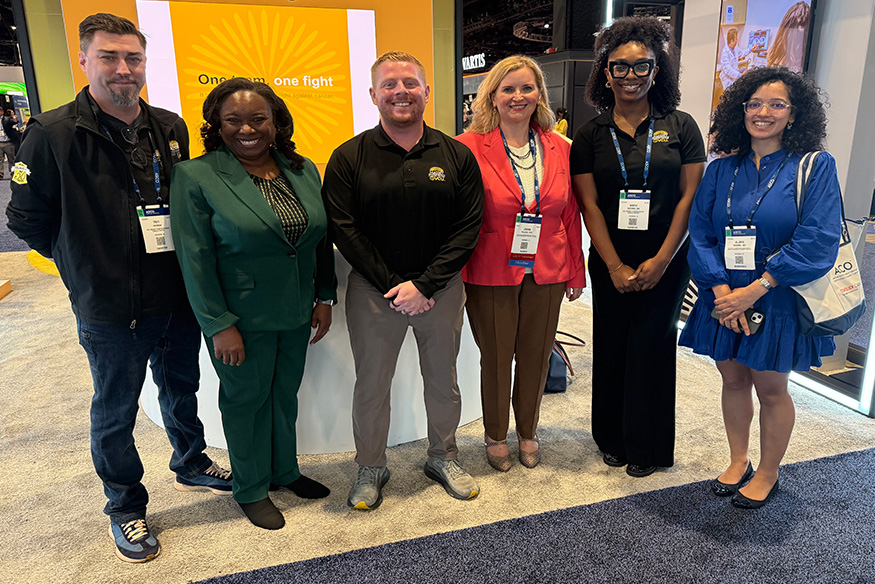 The Massey team proudly standing in the Massey booth while representing the cancer center and VCU at the 2026 ASCO Annual Meeting in Chicago, May 29-June 2.
VCU Massey Comprehensive Cancer Center continued to be at the forefront for high-impact, cutting-edge research with a strong presence at the 2026 American Society of Clinical Oncology (ASCO) Annual Meeting in Chicago from May 29-June 2.
The annual clinical oncology conference brings in more than 44,000 people with 7,400 exhibitors to McCormick Place “where groundbreaking science, innovation, and connection come together to shape the future of cancer care,” according to the organization’s website. This year’s theme centered on “The Science and Practice of Translation: Improving Cancer Outcomes Worldwide” with attendees represented from 166 different countries.
In the spirit of forging collaborations to change the landscape of cancer care, Virginia Commonwealth University and VCU Massey were represented on more than 30 poster presentations with the latest research in best clinical practices and innovative studies.
“ASCO’s annual meeting is the premiere site for the latest and most cutting-edge advances in clinical oncology,” said Monica L. Baskin, Ph.D., interim director of VCU Massey. “To see the work of Massey researchers presented on this international stage not only reinforces our caliber as a research organization, but also provides incredible opportunities for collaboration and learning which we can then bring back to our catchment area.”
Experts from VCU Massey attended the conference in-person to present their research, explore the latest cutting-edge research and network with experts from across the globe, including breakthroughs across multiple disciplines, from GLP-1 use and cancer outcomes to the effectiveness of specific microbiome modulation therapies for metastatic colorectal cancer, among many others. The VCU Massey booth served as a networking hub for attendees to learn more about one of the premier community-focused cancer centers in the nation, while also displaying Massey’s presence on an international stage.
Below are the poster presentations and research abstracts from this year’s ASCO Annual Meeting, featuring presenters or co-authors from Virginia Commonwealth University, VCU Massey and the VCU School of Medicine.
A phase II trial of neoadjuvant zanzalintinib (ZANZA) plus nivolumab (NIVO) in patients with locally advanced and/or surgically challenging clear cell renal cell carcinoma (EXPLORE-RCC)
- Summary: This clinical trial is evaluating a novel combination immunotherapy in patients with locally advanced kidney cancer.
- Presenter: Qian Qin, M.D.
- Co-authors: Jeffrey A. Cadeddu, Kris Gaston, Daniel M. Geynisman, Elshad Hasanov, Shilajit Kundu, Alexander Kutikov, Lin Lin, Jonathan Maldonado, Vitaly Margulis, John W. Melson, Asit K. Paul, Melissa A. Reimers, Eric A. Singer, Isamu Tachibana, David J. VanderWeele, Song Zhang, Tian Zhang, Matthew R. Zibelman
A randomized phase II study of selinexor added to standard induction and consolidation chemotherapy in adults with acute myeloid leukemia (AML)
- Summary: This randomized clinical trial showed that the addition of selinexor to standard chemotherapy in acute myeloid leukemia patients was associated with higher response rates and longer median overall survival compared with chemotherapy alone.
- Presenter: Timothy Pardee, M.D., Ph.D.
- Co-authors: Rupali R. Bhave, M.D., Madelyn Burkart, M.D., Sarah Dralle, NP, Leslie R. Ellis, M.D., Dianna Howard, M.D., Susan Lyerly, PA-C, Keri R. Maher, DO, Megan Manuel, Bayard L. Powell, M.D., Matthew J. Wieduwilt, M.D.
A retrospective cohort study evaluating cetuximab super-responders with recurrent or metastatic squamous cell carcinoma of the head and neck
- Summary: This study identified features associated with durable benefit in head and neck cancer patients treated with a key targeted therapy.
- Presenter: Joshua Bates
- Co-authors: Rami Hawlia, Renato Martins, M.D., Cristina Rodriguez, M.D.
“These findings support the existence of a subset of patients who derive exceptional and durable benefit from cetuximab, though the biologic or genetic basis underlying these responses remains unclear and warrants further investigation,” Bates said.
A study evaluating microbiome modulation therapy in patients undergoing first-line therapy for metastatic colorectal cancer
- Summary: This study is evaluating the addition of microbiome modulation therapy —including ciprofloxacin and metronidazole with or without aspirin—to standard first-line chemotherapy in patients with advanced colorectal cancer.
- Presenter: Emily Kinsey, M.D.
- Co-authors: Hamid Akbarali, Ph.D., Andrew Poklepovic, M.D., Katarzyna Tyc, Ph.D., Nolan Wages, Ph.D.
“This study investigates whether targeted modulation of the gut microbiome can enhance chemotherapy response and overcome resistance in metastatic colorectal cancer, representing a novel therapeutic strategy with potential to improve outcomes and address disparities,” Kinsey said.
Activity of NP-G2-044 (fascin inhibitor) + anti–PD-1 in ICI-resistant advanced/metastatic solid tumors with expansion in cutaneous squamous cell carcinoma (CSCC)
- Summary: This study supports fascin inhibition as an effective strategy to enhance immunotherapy treatment for immune-resistant cutaneous squamous cell carcinoma.
- Presenter: Andrew Poklepovic, M.D.
- Co-authors: Michael Birrer, M.D., Ph.D., Sanjay Chandrasekaran, M.D., Vincent Chung, M.D., Thomas George, M.D., FACP, Xin-Yun Huang, Ph.D., Jose Jimeno, M.D., Ph.D., Anup Kasi, M.D., MPH, Alberto Mendivil, M.D., Aaron Scott, M.D., Alexander Spira, M.D., Ph.D., Janos Tanyi, M.D., Ph.D., Frank Tsai, M.D., Jillian Zhang, Ph.D.
Alliance A072301: A phase III trial of radiotherapy followed by adjuvant temozolomide in combination with vorasidenib vs placebo in IDH-mutated newly diagnosed grade 3 astrocytoma (VORTEX)
- Summary: This trial evaluated the benefit of the addition of the IDH1 and IDH-2 inhibitor vorasidenib to adjuvant temozolomide versus placebo following standard radiotherapy to evaluate possible improvement in outcomes.
- Presenter: Ugonma Nnenna Chukwueke, MD, MPH
- Co-authors: Rifaquat Rahman, Susan M. Geyer, Rachael A. Vaubel, Ashlee Loughan, Timothy J. Kaufmann, Benjamin M. Ellingson, Sani H. Kizilbash, Amylou C. Dueck, Claire Yee, Christine Lu-Emerson, Julie J. Miller, Daniel M. Trifiletti, Jeffrey S. Wefel, Priya Kumthekar, Evanthia Galanis, Patrick Y. Wen
Association of heparinoids exposure with cytokine release syndrome–related morbidity and mortality in patients receiving CAR-T or BITE therapies
- Summary: These findings suggest that heparinoid exposure is associated with cytokine release syndrome and poor overall survival in patients receiving CAR-T and bispecific T-cell engaging therapies.
- Presenter: Carolina Velez-Mejia, M.D.
- Co-authors: Hui Lin, M.D., Bhaumik Patel, M.D., Nilang Patel, M.D., Sneha Purvey, M.D.
Clinical and translational study of p38 inhibitor pexmetinib plus nivolumab following anti–PD-1/L1 failure in advanced solid tumors
- Summary: This study suggests that targeting tumor-intrinsic p38 MAPK could be an effective therapeutic strategy to overcome immunotherapy resistance in advanced solid tumors.
- Presenter: Matthew Nguyen, M.D.
- Co-authors: Mohammadreza Amjadzadeh, Riyue Bao, Ph.D., Rebekah Dadey, Ph.D., Mark Jelinek, Hyun Lee, M.D., Jason Luke, M.D., Andrew Poklepovic, M.D., Dan Zandberg, M.D.
Consumer wearables and medical care utilization in gastrointestinal cancers: A Fitbit data analysis in NIH All of Us Research Program
- Summary: This study examined associations between activity levels and delayed or forgone care among adults with gastrointestinal cancers.
- Presenter: Osama Elkhider, M.D., MBBS
- Co-author: Alisha Sharma, M.D.
Cost of cytokine release syndrome in patients treated with tarlatamab for extensive-stage small cell lung cancer based on first-line treatment
- Summary: This analysis suggests that the clinical decisions made in the first-line setting for patients with advanced small cell lung cancer do not appear to affect the medical cost of managing cytokine release syndrome following tarlatamab treatment.
- Presenter: Joshua Walter Zweigle, M.D.
- Co-author: Renato Martins, M.D.
“This research will allow oncologists to make decisions about the cost of care for their small cell lung cancer patients without needing to adjust the differential cost of cytokine release syndrome based upon each first line treatment,” Zweigle said.
Developing quality cancer survivorship care competencies for primary care: A modified Delphi study
- Summary: This study determined that competencies in cancer survivorship tailored for primary care are a critical step needed to train current and future primary care clinicians.
- Presenter: Youngjee Choi, MD, FACP
- Co-authors: Rebecca L. Eary, Melissa Erickson, Pamela Ganschow, Katherine R. Gilmore, Susan Hong, Jennifer Kim, Deborah J. Manst, Sean McClellan, Allison McDonough, Kimberly S. Peairs, Archana Radhakrishnan, Michael Roth, Lidia Schapira, Samantha B. Siegel, Alique G. Topalian, Ilana Yurkiewicz, Larissa Nekhlyudov
Differences in outcomes for elderly patients with DLBCL treated at academic vs community programs: A 10-year survival analysis
- Summary: This retrospective analysis highlights an opportunity to optimize treatment delivery and intensity, supportive care, and geriatric-focused management in both academic and community programs.
- Presenter: Carolina Velez-Mejia, MD
- Co-authors: Perla Colunga, Luis Villela, Qianqian Liu, Joel Michalek, Adolfo E. Diaz Duque
“This research shows an opportunity to target and include elderly patients in upcoming clinical trials, evaluate alternative treatment options to improve the overall survival for this frail population and create an integrated ACP-CCP care model,” Velez-Mejia said.
Effects of upfront dual immunotherapy on overall survival in patients with metastatic non-small cell lung cancer with no targetable mutations or PD-L1 expression
- Summary: This study concluded that advanced lung cancer patients—with no targetable mutations and no PDL1 expression—demonstrated improved overall survival when treated with dual immunotherapy compared to a combination of chemotherapy and immunotherapy in the first-line setting.
- Presenter: Esteban Toro Velez, M.D.
- Co-authors: Renato Martins, M.D., Andrew Poklepovic, M.D., Carolina Velez-Mejia, M.D.
Evaluating AFP–liver reserve discordance and microvascular invasion in resected and transplanted hepatocellular carcinoma
- Summary: These findings support incorporating alpha-fetoprotein liver reserve phenotypes into a unified staging or risk framework to enhance prognostic accuracy in liver cancer.
- Presenter: Devi Preetham Veeramgari
- Co-authors: Hassaan Abbasi, David Bruno, Adrian Cotterell, Daisuke Imai, Yonatan Kaplan, Aamir Khan, Vinay Kumaran, Hannah Lee, Seung D. Lee, Shavaiz Manzoor, Muhammad Saeed, Yuzuru Sambommatsu, Amit Sharma
Exploring pancreatic cancer risk in rheumatoid arthritis and role of rheumatoid factor test: A retrospective cohort study using NIH All of Us database
- Summary: This study showed that rheumatoid arthritis is an independent risk factor for pancreatic cancer; however, rheumatoid factor testing and positivity may not have significant utility for pancreatic cancer screening or prognosis.
- Presenter: Alisha Sharma, M.D.
- Co-authors: Osama Elkhider, M.D., MBBS, Prasun Pudasainee, M.D., Bimatshu Pyakuryal, MBBS, Kritika Yadav, M.D.
Health-related quality of life (HRQOL) in the phase 3 trial of standard chemotherapy alone or combined with atezolizumab as adjuvant therapy for patients with stage III deficient DNA mismatch repair (dMMR) colon cancer (Alliance A021502, ATOMIC)
- Summary: These results support the tolerability of the combination of atezolizumab and mFOLFOX6 as a standard of care adjuvant treatment for patients with dMMR stage III colon cancer.
- Presenter: Amylou Dueck, Ph.D.
- Co-authors: Dirk Arnold, Robert J. Behrens, Deirdre J. Cohen, Wendy L. Frankel, Briant Fruth, Clare A. Gatten, Dennis Hsu, Christopher Lieu, Khalid Matin, Jeffrey A. Meyerhardt, Fang-Shu Ou, Eileen M. O'Reilly, Walter Peters, Samara L. Potter, Anke C. Reinacher-Schick, Ardaman Shergill, Frank A. Sinicrope, Peter Trask, Tyler Zemla
Impact of facility type on outcomes for elderly patients (≥ 75 years) with Burkitt lymphoma: Real-world data of academic vs community cancer programs
- Summary: The findings from this retrospective analysis highlight the persistent vulnerability of elderly patients with Burkitt lymphoma and reinforce the need for integrated ACP-CCP care models.
- Presenter: Carolina Velez-Mejia, MD
- Co-authors: Luis F. Rubalcava, Alfredo Quiroz, Joel Michalek, Qianqian Liu, Adolfo E. Diaz Duque
Inpatient chemotherapy in lung cancer: Survival outcomes in small cell and non–small cell lung cancer
- Summary: This analysis found there was no survival difference for small cell lung cancer patients whose treatment was initiated in both the inpatient and outpatient settings.
- Presenter: Esteban Toro Velez, M.D.
- Co-authors: Renato Martins, M.D., Andrew Poklepovic, M.D., Carolina Velez-Mejia, M.D.
Medicaid expansion and timely colorectal cancer treatment initiation among young adults in Virginia
- Summary: This study found that, among insured colorectal cancer survivors aged 18–54 in Virginia, patients with Medicaid insurance were associated with lower odds of treatment within 30 days compared to commercial health insurance coverage.
- Presenter: Paulette Omeaku, MPH
- Co-authors: Erin Britton, Ph.D., MPH, Derek Chapman, Ph.D., Bassam Dahman, Ph.D., Anika Hines, Ph.D., MPH, Arnethea Sutton, Ph.D.
Overall survival in patients with extensive stage small cell lung cancer treated with durvalumab instead of atezolizumab
- Summary: This is believed to be the first large-scale study that compares two different immunotherapies—durvalumab or atezolizumab—in patients treated for extensive-stage small cell lung cancer. Patients treated with durvalumab had statistically better overall survival.
- Presenter: Esteban Toro Velez, M.D.
- Co-authors: Renato Martins, M.D., Andrew Poklepovic, M.D., Dominique Smith, PharmD, Carolina Velez-Mejia, M.D.
Pathologic treatment effect and first recurrence behavior after curative liver surgery for HCC
- Summary: This research demonstrated that pathologic treatment effect did not improve prediction of post-surgical recurrence outcomes among liver cancer patients.
- Presenter: Hassaan Abbasi, MHS
- Co-authors: David Bruno, Adrian Cotterell, Jacob D. Hallesy, Daisuke Imai, Vinay Kumaran, Hannah Lee, Seung D. Lee, Shavaiz Manzoor, Devi Preetham Veeramgari, Muhammad Saeed, Yuzuru Sambommatsu, Amit Sharma
Phase 1A/B study of AB248, a CD8+ selective IL-2 mutein fusion protein, alone or in combination with pembrolizumab, in patients with advanced solid tumor malignancies
- Summary: This clinical trial showed that AB248 demonstrates robust anti-tumor activity among metastatic melanoma patients heavily pretreated with immunotherapy.
- Presenter: Harriet Kluger, M.D.
- Co-authors: Alain P. Algazi, Rama Balaraman, Elizabeth I. Buchbinder, Wanxing Chai-Ho, Monica F. Chen, Gregory A. Daniels, Ivana Djuretic, Tarik Hadid, Leonel F. Hernandez-Aya, Essie Liu, Janice M. Mehnert, Daniel Morgensztern, Daniel Olson, Andrew S. Poklepovic, Adam Rock, David R. Spigel, Mario Sznol, Jeffrey Ward, Sarah A. Weiss
Prediction of anthracycline-related cardiomyopathy in long-term childhood cancer survivors: The power of survivor-specific polygenic risk score—A COG-ALTE03N1 study
- Summary: This matched case-control study showed integrating a survivor-specific polygenic risk score—derived from a set of biologically plausible genetic variants with readily-available clinical factors—informs cardiomyopathy risk classification in childhood cancer survivors and provides an opportunity to develop personalized screening recommendations and behavioral/therapeutic interventions.
- Presenter: Noha Sharafeldin, MD, PhD, MSc
- Co-authors: Liting Zhou, Xuexia Wang, Patrick Trainor, Purnima Singh, Lindsey Hageman, Saro Armenian, Jill P. Ginsberg, Joseph P. Neglia, Naomi J. Winick, Wendy Landier, Smita Bhatia
Pregnancy outcomes in women with myeloproliferative neoplasms: A multicenter real-world analysis
- Summary: This retrospective cohort study evaluated pregnancy-related outcomes in women with myeloproliferative neoplasms and examined potential risk predictors.
- Presenter: Maryam Naser, MBBS
- Co-author: Ruchi Desai, M.D.
Real-world outcomes of biomarker-intended pembrolizumab use in soft tissue sarcomas
- Summary: These findings support the application of biomarker-intended pembrolizumab use in advanced soft tissue sarcomas.
- Presenter: Keun Lee, M.D.
- Co-author: Hyun Lee, M.D.
Real-world outcomes of doxorubicin and paclitaxel in advanced Kaposi sarcoma: A TriNetX retrospective cohort study
- Summary: This analysis provides a contemporary assessment of doxorubicin and paclitaxel in advanced Kaposi sarcoma, with a particular focus on HIV-associated disease.
- Presenter: Keun Lee, M.D.
- Co-authors: Yagmur Bingul, Hyun Lee, M.D.
“One important finding was that HIV-positive patients treated with doxorubicin appeared to have especially good outcomes. We conclude that doxorubicin may be a strong treatment option for HIV-positive patients with advanced Kaposi sarcoma, but future studies are needed to confirm this,” Hyun Lee said.
Relationship between GLP-1 receptor agonists on cancer recurrence and survival of patients with stage I-III colorectal cancer: A retrospective cohort study using the TriNetX database
- Summary: This analysis indicates that GLP-1 receptor agonist use among colorectal cancer patients was associated with improved survival.
- Presenter: Emily Kinsey, M.D.
- Co-authors: Obinna Diala, M.D., MPH, Bernard Fuemmeler, Ph.D., MPH, Racheal Oladimeji, Andrew Poklepovic, M.D., Alisha Sharma, M.D., Kristina Tatum, PsyD, Carolina Velez-Mejia, M.D., Sarah Williford
“This study shows GLP-1s should be explored as a way to reduce colorectal cancer recurrence,” Kinsey said.
Role of iron supplementation in the efficacy of immune checkpoint inhibitors (ICIs): A real-world propensity-matched analysis
- Summary: This study highlights the adverse impact of concurrent iron supplementation in patients receiving immune checkpoint inhibitors, especially in patients without a true iron deficiency.
- Presenter: Partha Sharma, MBBS
- Co-author: Uzma Athar, M.D., Sejal Kothadia, M.D., Alexander Neuwelt, M.D., Bhaumik Patel, M.D.
“These results suggest carefully evaluating whether patients actually have iron deficiency before prescribing iron during immune checkpoint inhibitor treatment, and future clinical studies should account for the type of anemia and method of iron supplementation,” Sharma said.
Safety and performance results from PATHFINDER 2, a registrational study of a multi-cancer early detection (MCED) test in an intended-use population
- Summary: This study is a large, prospective, multicenter, interventional study of a multi-cancer blood test’s performance and safety in a diverse U.S. population.
- Presenter: Karthik Giridhar, M.D.
- Co-authors: Michael J. Demeure, Shirish M. Gadgeel, Rebecca D. Kaltman, Raymond Kim, Dax Kurbegov, James W. Lillard, Rita Lopatin, Celine Marquez, Marc R. Matrana, Margaret E. McCusker, Charles H. McDonnell III, Nima Nabavizadeh, Kevin C. Oeffinger, Andrew S. Poklepovic, Donald A. Richards, Alan Roth, Gretchen Stipec, Sami Tahhan, Jennifer Tran
Support of academic non-clinical efforts for cancer investigator faculty at Association of American Cancer Institutes
- Summary: This survey highlights systemic failures in institutional support for clinical cancer investigators nationwide, and underscores the need for sustainable funding models and robust mentoring pathways to retain and advance clinical researchers.
- Presenter: Karen Reckamp, M.D.
- Co-authors: Paula M. Fracasso, Ph.D., Kendra Cameron, Thomas J. George, Hailey Honeycutt, Jenna Hoopes, Carrie B. Lee, Christopher Lieu, Quan P. Ly, Stephanie J. Si Lim, Kate Shaw, Nicole L. Simone, Julie A. Sosa, Julie Vose, Theresa L. Werner, Julia R. White, Lee G. Wilke
Survival in patients with hepatobiliary and pancreatic cancers taking GLP-1 receptor agonist therapy
- Summary: This research suggests that patients with hepatobiliary and pancreatic malignancies receiving GLP-1 therapy demonstrated better survival outcomes.
- Presenter: Carolina Velez-Mejia, M.D.
- Co-authors: Emily Kinsey, M.D., Andrew Poklepovic, M.D., Dominique Smith, PharmD, Esteban Toro Velez, M.D.
Written by: Blake Belden, Preston Willett
Related News
Research & Innovation
Depression and stress drive long-term fatigue for breast cancer survivorsSep 3, 2026

Get access to new, innovative care
Treatments in clinical trials may be more effective or have fewer side effects than the treatments that are currently available. With more than 200 studies for multiple types of cancers and cancer prevention, Massey supports a wide array of clinical trials.

Find a provider
Massey supports hundreds of top cancer specialists serving the needs of our patients. Massey’s medical team provides a wealth of expertise in cancer diagnosis, treatment, prevention and symptom management.