
Latest News
Research & Innovation
Targeted biological missile blocks growth of aggressive leukemia
Apr 29, 2026
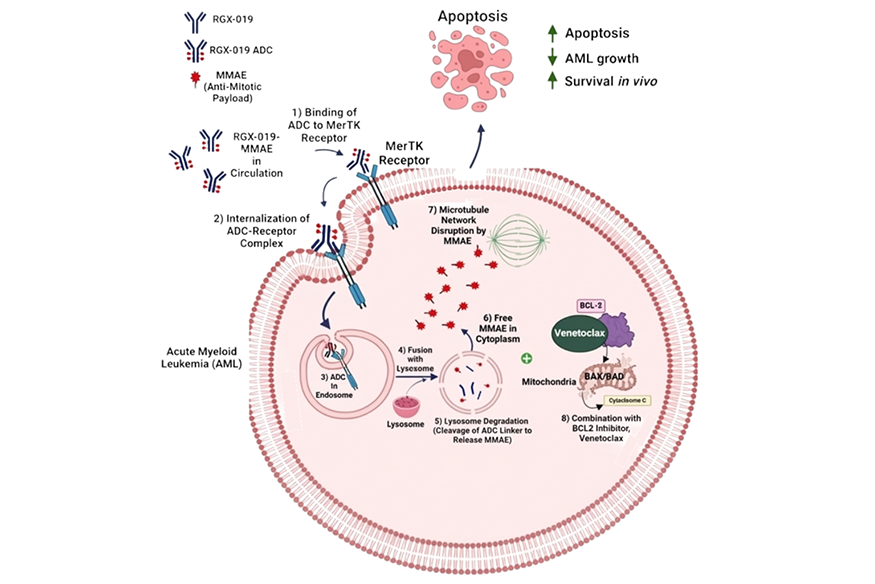 This graphical abstract illustrates how research out of VCU Massey Comprehensive Cancer Center targeted the MerTK kinase receptor in acute myeloid leukemia. (Tyagi, A., Siddiqui, M., Eckstrom, A. et al.).
New research out of VCU Massey Comprehensive Cancer Center has uncovered a targeted cancer therapy that significantly prevents leukemia progression, improves survival rates and minimizes damage to surrounding healthy tissue.
Published in the Journal of Experimental & Clinical Cancer Research, this is the first-ever study to investigate the effectiveness of targeting the MERTK kinase receptor using antibody-drug conjugates in acute myeloid leukemia (AML).
About acute myeloid leukemia
- Type of blood cancer that begins in the bone marrow
- Most common form of leukemia in adults in the U.S.
- Highly aggressive; fast growing
- Poor long-term survival
“While standard treatments such as intensive chemotherapy and stem cell transplantation can be effective for some AML patients, many patients do not respond or eventually relapse,” said V. Lokesh Battula, Ph.D., senior author of the study and assistant director of Cancer Research Training and Education Coordination efforts at Massey. “There is a desperate need to develop more effective and durable targeted treatments for aggressive AML.”
What are antibody-drug conjugates?
Antibody-drug conjugates (ADCs) are highly targeted cancer therapies, often referred to as a “biological missile,” Battula said.
ADCs involve three main components:
- A monoclonal antibody: Lab-generated immune proteins—that selectively targets and binds to an antigen on cancer cells. In this study, that antigen is MERTK.
- A chemical bridge: Also known as linker, connects the antibody to a drug that is intended to attack the cancer.
- Payload: The drug is actively delivered to the cancer, disrupting cell division and killing cancer cells.
What is MERTK?
- MERTK is a gene—a member of the TAM family of kinase receptors—that plays essential roles in tissue homeostasis, the removal of dying cells and immune response regulation.
- MERTK also plays a significant role in tumor growth because it helps regulate cancer cell survival.
- It is overactive in approximately 80% of all patients who have AML, particularly in the monocytic subtype.
Monocytic leukemia is a specific subset of AML where the cancer cells arise from monocytic precursors, which occurs when immature cells that are expected to develop into white blood cells (monocytes) turn cancerous.
The research findings
Battula and his research team experimented with a new ADC—RGX-019-MMAE—that targets and binds to the MERTK receptor. In preclinical models, they found that it effectively dismantled the growth and spread of leukemic cells, while sparing healthy tissue surrounding the cancer, with high selectivity.
“This ADC can specifically target AML cells while reducing harmful side effects, such as anemia, which is commonly seen with conventional chemotherapy,” Battula said.
Additionally, they demonstrated increased effectiveness when RGX-019-MMAE was combined with venetoclax, an approved targeted treatment for AML that inhibits the BCL-2 protein, which is overexpressed in cancer cells.
“Our findings suggest the potential for a more effective combination therapy for leukemia, particularly difficult-to-treat AML,” Battula said.
What’s next?
Using patient-derived xenograft models, the research team plans to evaluate the long-term safety and toxicity of RGX-019-MMAE, as well as potential cancer resistance properties to the treatment.
Battula said they intend to confirm optimum dosing strategies to be able to initiate clinical trials to test the drug, and to identify potential combination treatment options that could improve patient outcomes in AML.
Collaborators
- Lead author: Anudishi Tyagi, Ph.D., of the Division of Hematology, Oncology and Palliative Care at the VCU School of Medicine
- Scientists from Inspirna, Inc. and the University of Texas MD Anderson Cancer Center
This research was funded by:
- Inspirna, Inc.
- National Cancer Institute
- The University of Texas MD Anderson Cancer Center
Written by: Blake Belden, Tatiana Del Valle
Related News
Research & Innovation
VCU Massey researchers receive $2.5M NIH grant to inform breast, pancreatic cancer careSep 9, 2026

Get access to new, innovative care
Treatments in clinical trials may be more effective or have fewer side effects than the treatments that are currently available. With more than 200 studies for multiple types of cancers and cancer prevention, Massey supports a wide array of clinical trials.

Find a provider
Massey supports hundreds of top cancer specialists serving the needs of our patients. Massey’s medical team provides a wealth of expertise in cancer diagnosis, treatment, prevention and symptom management.