Latest News
Clinical Care, Patient Stories
“Thankfully, we will never know what that journey would have been.” How genetic testing opened up opportunities for twin sisters
Nov 23, 2026
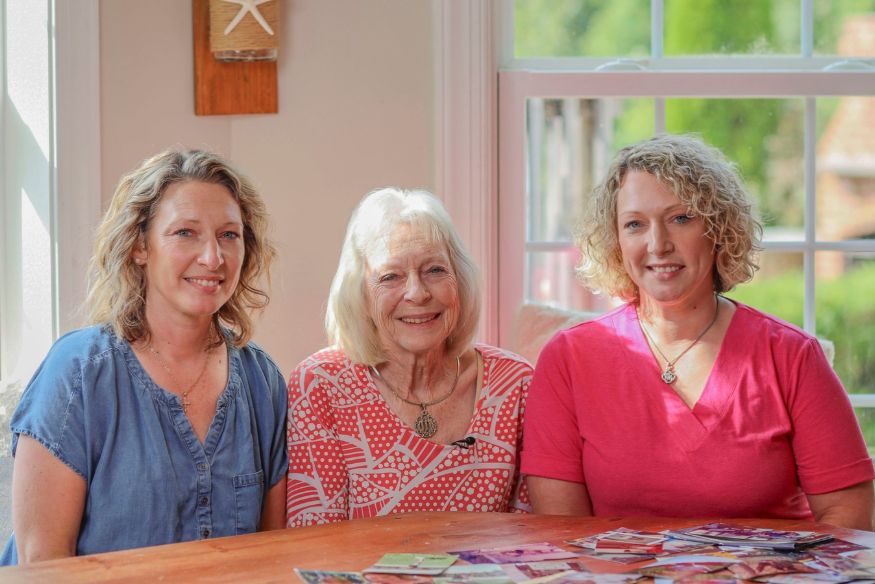 (from left) Beckie Langford, Mary Kay Bright, Lorrie Taylor have all been impacted by breast cancer.
Lorrie Taylor, BSN, and her twin sister, Beckie Langford, RRT, knew the statistics. They had seen multiple women on their mother’s side of the family develop and fight breast cancer. Still, Lorrie’s initial diagnosis of invasive ductal carcinoma in 2023 came as a shock.
“I just kind of went numb, and I couldn’t say anything,” Lorrie recalled. “And my mom [Mary Kay Bright] was teary-eyed. My husband, he was just bawling and he’s looking at me and I’m just like, ‘What do we do now?’”
Soon after the initial diagnosis, further testing revealed a hidden gene that would come to cause issues for many women in Lorrie’s family. The PAL-B2 gene was the reason for Lorrie’s triple-negative breast cancer but doctors said it would likely affect her twin, Beckie, too.
This left Beckie with a choice: to wait and see what the future would bring, knowing she shared her sister’s genetic mutation, or to pursue a preventative path.
Stopping cancer in its tracks with genetic testing
Cancer care has gone from playing defense, to having a solid offensive game as well, stopping cancer before it can even be detected. In 1996, genetic testing gained traction in cancer care when clinical screenings for BRCA1/2 mutations launched publicly for high-risk patients. Over the last 30 years, genetic testing has expanded into a routine part of cancer care and has saved countless lives.
VCU Massey Comprehensive Cancer Center has a team of genetic counselors certified by the American Board of Genetic Counseling. They help people both with and without cancer to develop a cancer prevention or treatment plan for themselves and their families. Included in Massey’s services are a full range of testing for inherited mutations for all types of cancers, as well as access to clinical trials.
For Jose Trevino, M.D., surgeon-in-chief, member of the Developmental Therapeutics research program and Geoffrey R. Shudtz Chair in Pancreatic Cancer Research at Massey, the potential need for genetic testing starts with a thorough examination of a family’s history.
“Our staff – from our medical assistants to our nurses, our physicians, our students, residents and fellows – all of us are asking the same questions over and over to identify key factors that might lead us to genetic testing,” Trevino said. “And VCU Massey Comprehensive Cancer Center does a great job in asking these questions and identifying the key components for people who have genetic mutations that put them at a higher risk of developing cancer.”
In identifying these patients, Massey providers can identify pre-malignant lesions, treat them or, in some cases, remove them surgically before they turn into cancer.
Those who carry a PAL-B2 mutation have a higher risk of developing breast cancer, which leads to earlier mammography and potentially MRIs to search the tissue for potential pre-cancerous lesions.
“When we find lesions, we either biopsy them or discuss with the patient about potentially removing the breast(s) to avoid the possibility of breast cancer occurrence in the future,” Trevino said.
Taking action after cancer screening reveals hereditary risk
For Beckie, there were no second thoughts about pursuing genetic testing after Lorrie’s diagnosis and subsequent finding of the PAL-B2 mutation.
“I was like, ‘if you got it, I got it,’” Beckie said. “We’re identical twins, so in my mind I knew that I might need to do something... I wanted to know — just let me know so I could do the preventative measures.”
Imaging initially did not show any signs of cancer, leaving Beckie hesitant to have her own double mastectomy. However, after her mother, Mary Kay, was diagnosed with breast cancer, Beckie ultimately decided to move forward with the procedure.
Even without a formal cancer diagnosis, Beckie felt in good hands with her Massey team.
“Going into the doctor’s offices, they already had a plan in place for everything that I was going through. They treated me as if I did have cancer because they just wanted to make sure they weren’t missing anything. It was very much like a family would treat you.”
It wasn’t until the double mastectomy was completed and the breast tissue was tested that Beckie found out there was cancer in her breasts that previously went undetected.
Through early detection and genetic testing, Lorrie altered Beckie’s cancer journey.
“The double mastectomy was the solution to what I had,” Beckie said. “I did not have to work while having chemo, I didn’t have to have chemo at all. Thankfully, we will never know what that journey would have been.”
The inspiration from Lorrie and Beckie then prompted additional members of their extended family to be tested for the PAL-B2 mutation, resulting in another family member receiving a preventative mastectomy.
In fact, Mary Kay’s breast cancer diagnosis came about directly because of her daughters’ diagnosis.
“It’s easy to stick your head in the sand and pretend like you’re not ever going to get it, but you just need to know early so it can be treated,” she said. “Mine was found early and treated, thanks to my daughters. It’s definitely a benefit, and I would do it again.”
Turning to VCU Health for rural cancer care
Nearly one year to the day after her initial cancer diagnosis, Lorrie’s world was rocked in spring 2024 after learning the cancer had come back. This time, there was no hesitation about where she would turn for care - the place where they both worked – VCU Health Tappahannock Hospital.
“I had seen Beckie’s care at Massey, and I was calling before I even had my discharge papers,” Lorrie said. “And VCU Massey [Comprehensive] Cancer Center was able to get me an appointment earlier than my own oncologist.”
The Massey Cancer Service Line, a programmatic approach that brings together a multi-disciplinary team of specialists, developed Lorrie’s care plan, and their commitment to her treatment brought her comfort.
“I really did feel like I was part of the team there. I met the plastic surgeon, the oncologist, the breast surgeon, and the radiologist — I met everybody,” Lorrie said.
She recalls her husband feeling the same way.
“He said, ‘it is the first time I feel like someone cares about you and wants to do something about it instead of just treating it like another doctor’s appointment,’” Lorrie said.
The 42-year-old mother of four faced another 11 months of intense treatment, including chemo, immunotherapy and surgery to remove the lymph nodes from her arm. Thankfully, most of that treatment could be done close to home at Tappahannock Hospital. Lorrie was at the hospital’s infusion center nearly every day. “I got very familiar with everyone.”
“The commitment to rural healthcare has been long standing at VCU Health and Massey,” said Renato Martins, M.D., chief of the Division of Hematology, Oncology and Palliative Care at Massey. “We have a number of highly specialized services that are provided both at [VCU Health] Tappahannock and VCU Community Memorial Hospital in South Hill, and they bring the same quality of care that we have here in Richmond to these communities, meeting them where they are.”
Being closer to home allowed her to be more present for her children.
“It was amazing. My husband would take me to treatments and then we would still have time to get the kids from school,” Lorrie said. “It was so important for them to have as normal of a life as possible while I was going through that.”
Sisters and survivors forever bonded through breast cancer journey
Beckie and Lorrie now dedicate their free time telling anyone who will listen about the importance of early detection.
“Unfortunately, since I’ve gone through this, I’ve had more and more friends that have been diagnosed,” Lorrie said. “I can’t stress enough the early detection, the exams, the mammograms, the genetic testing.”
Both Lorrie and Beckie are here today because of each other.
“When we were small, we were built-in buddies, built-in best friends,” Beckie said. “You always had somebody. You didn’t have to do anything alone. You had somebody with you.”
Bonded by more than just DNA, Beckie and Lorrie continue to lean on each other daily.
As they held hands while relaying an anecdote in which Beckie was bemoaning something minor when the two of them stood at the nurse’s stand at the hospital, Lorrie smiled, “I was like, ‘Beckie, I have had cancer. If I can get through that, then you can get through anything.’”
And as only a sister can, Beckie retorted, “Here you go with the cancer card again.”
They both looked at each other and laughed, knowing that they have a future full of ribbing each other and strengthening those forever bonds.
Written by: Bill Potter
Related News
Clinical Care, Prevention
Lung Cancer Awareness Month: Reduce your risk, identify the signs and get screenedNov 23, 2026
Clinical Care, Prevention
Eating healthy can help maintain nutrition and prevent the winter blues over the holidaysNov 20, 2026
Research & Innovation, Clinical Care
Massey becomes first academic cancer center in Virginia to offer hepatic artery infusion pump therapyNov 5, 2026

Get access to new, innovative care
Treatments in clinical trials may be more effective or have fewer side effects than the treatments that are currently available. With more than 200 studies for multiple types of cancers and cancer prevention, Massey supports a wide array of clinical trials.
Find a provider
Massey supports hundreds of top cancer specialists serving the needs of our patients. Massey’s medical team provides a wealth of expertise in cancer diagnosis, treatment, prevention and symptom management.