Latest News
Research & Innovation, Clinical Care
How an NIH pilot grant at VCU helped Massey researchers launch a precision medicine company
Oct 20, 2026
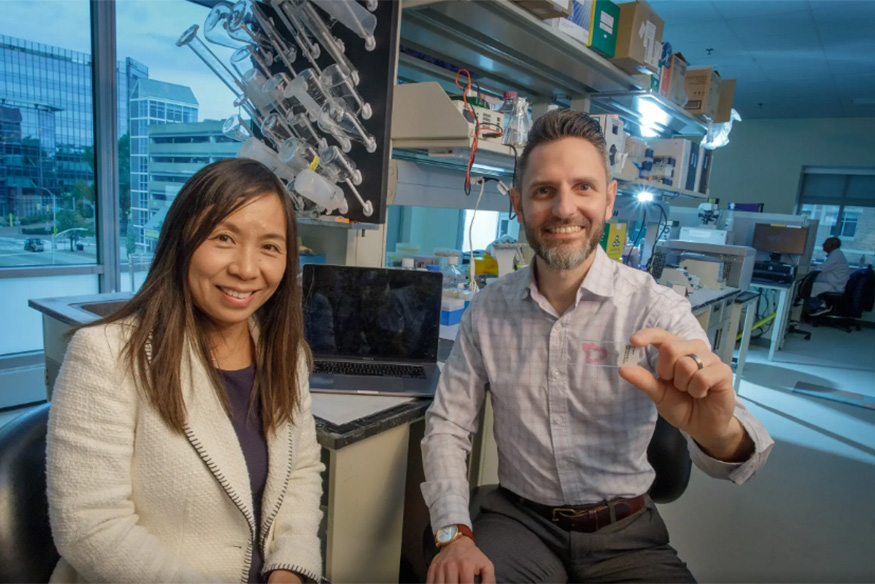 Jinze Liu, Ph.D., and Kevin Matthew Byrd, D.D.S., Ph.D., build virtual tissues for precision medicine. (Credit: Karl E. Steinbrenner)
The human body is not flat. It is a crowded, three-dimensional world, built from trillions of cells that live side by side, lean on their neighbors and constantly trade signals. A cancer cell is dangerous not only because of what it is, but because of the company it keeps and where it sits. To understand disease — and to beat it — scientists need to understand not only what each cell is, but where it lives, who it communicates with, and how those relationships change during health and disease.
For a long time, scientists could not reach this understanding. Now, thanks in large part to a small pilot grant at Virginia Commonwealth University, they can.
One pivotal chapter began in 2024, when Jinze Liu, Ph.D., the director of Bioinformatics Shared Resource at VCU Massey Comprehensive Cancer Center, won a Translational Science Pilot Grant from the Wright Regional Center for Clinical and Translational Science, the home of Virginia's Clinical and Translational Science Award. Liu is also a professor of biostatistics at the VCU School of Public Health and co-lead for Health Informatics at the Wright Center. Her funded project took aim at one of the hardest problems in a fast-growing field called spatial biology.
Spatial biology lets scientists map the location and interactions of cells inside tissue, keeping the context that older methods threw away. But there was a catch. Sorting millions of cells into their correct types was painfully slow, often done by hand by expert pathologists. Identifying cells in a single tissue sample could take more than a month.
That is the wall Liu and her pilot-grant team set out to break. Joining her as co-investigators were Katarzyna Tyc, Ph.D., a member of the Cancer Prevention and Control research program at Massey and an assistant professor in the Department of Biostatistics in VCU’s School of Public Health, who developed the algorithm along with Khoa Huynh, Ph.D., then a graduate student in biostatistics; and Kevin Matthew Byrd, D.D.S., Ph.D., a member of the Cancer Biology research program at Massey and an assistant professor of oral and craniofacial molecular biology at the VCU School of Dentistry, who supplied tissue data and expert cell labeling.
The pilot also supported the doctoral training of Huynh, who implemented the TACIT algorithm and earned his Ph.D. in biostatistics in 2025. Together they published TACIT — short for Threshold-based Assignment of Cell Types from Multiplexed Imaging Data. While TACIT solved the immediate challenge of rapidly annotating spatial biology data, it also established the computational foundation for a much broader platform capable of reconstructing virtual tissues and modeling disease at cellular resolution.
TACIT reads high-resolution images of tissue and sorts cells by type in minutes instead of months, leveraging machine-learning algorithms. To train and test it, the team used data from 5 million cells and 51 cell types across three very different parts of the body: the brain, the intestine and glandular tissues. In tests against three widely used methods, TACIT lined up more closely with expert annotations, scaled to much larger datasets, and was especially good at spotting rare cell types that other tools often miss.
"We're using artificial intelligence to increase efficiency and also the accuracy of diagnosis," Liu said.
Viewing tumors as living neighborhoods
What makes the technology feel almost magical is what it reveals once the cells are named. A tumor stops being a blur and becomes a living neighborhood whose organization helps determine how disease develops, progresses and responds to therapy.
Byrd puts it this way: with these tools, a single cell "now lives in a network of other cells" — a snapshot of the tissue frozen in time. That network view matters in many diseases, especially in cancer, where nearby immune cells, blood vessels and support cells can decide whether a tumor spreads or is held in check. Seeing those relationships in three dimensions, rather than one cell at a time, is what turns a picture into an understanding of the disease.
Matching each patient to the right treatment
The payoff for patients could be enormous. Because the technology works across almost any tissue and disease, doctors could one day use its detailed maps to catch disease earlier, follow how it changes and match each person to the right treatment. That tailored approach is the heart of precision medicine.
The team is already testing that promise. In one research collaboration, TACIT helped identify spatial cellular patterns that distinguished patients according to treatment response.
Byrd imagines a day when a cellular map points straight to a therapy already sitting on the shelf. "Imagine if you could tell a patient, 'Here's an already [FDA] approved drug,'" he said.
A remarkable return on investment
That early NIH-funded pilot has paid off in a big way. In April 2025, Liu and Byrd published TACIT in Nature Communications, one of the world's top journals. The work generated patent-pending intellectual property. And in September 2024, they co-founded the VCU spinout, Stratica Biosciences, with Byrd as chief executive officer and Liu as chief technology officer. TACIT was an important starting point for the company, which has since expanded beyond the original technology and is developing StraticaOS, an integrated platform for building virtual tissues for precision medicine.
Building on that foundation, Liu and Byrd developed a broader set of AI-powered tools for interpreting high-resolution tissue images, identifying cell types and molecular features, and mapping how cells interact in space. In early 2025, the broader technology program received a VCU Commercialization Fund award to help move the technology closer to market. Those awards are given by the Office of the Vice President for Research and Innovation’s TechTransfer and Ventures Team, which has helped protect Liu’s intellectual property and is helping position Stratica’s technology to reach clinics, trials and industry partners.
The impact extends well beyond a single publication or invention. Stratica has moved past early investment to generate commercial revenue through paid collaborations with pharmaceutical companies, foundations and academic partners, while the technology has drawn substantial follow-on federal, foundation and institutional support. Each new application generates fresh data, tests the methods in new biological settings and helps expand the platform — a self-reinforcing engine for translational discovery. For a single early-stage pilot, that is an outsized payoff, even before accounting for the value of the patent-pending technology, the publications or the new doors opening with hospitals and drug makers.
"This is precisely the outcome VCU’s research enterprise is built to produce," said P. Srirama Rao, Ph.D., VCU's vice president for research and innovation. "A pilot grant from the Wright Center and commercialization support from TechTransfer and Ventures moved a powerful idea from the lab into the world. Technologies like TACIT and StraticaOS represent exactly the kind of impact we hope to see across every disease area — a result of our research and innovation offices working as one."
The project described above was in part supported by CTSA award No. UM1TR004360 from the National Center for Advancing Translational Sciences. Its contents are solely the responsibility of the authors and do not necessarily represent official views of the NCATS or the National Institutes of Health.
This was repurposed from an article originally published by VCU News.
Written by: Christopher Richmond
Related News
Research & Innovation, Clinical Care, Prevention , Leadership
International community gathers for 2026 Global Cardio-Oncology Summit in WilliamsburgOct 14, 2026
Research & Innovation
Simulating cellular environments to fight advanced prostate cancerOct 7, 2026

Get access to new, innovative care
Treatments in clinical trials may be more effective or have fewer side effects than the treatments that are currently available. With more than 200 studies for multiple types of cancers and cancer prevention, Massey supports a wide array of clinical trials.

Find a provider
Massey supports hundreds of top cancer specialists serving the needs of our patients. Massey’s medical team provides a wealth of expertise in cancer diagnosis, treatment, prevention and symptom management.