Latest News
Research & Innovation, Clinical Care, Prevention , Leadership
International community gathers for 2026 Global Cardio-Oncology Summit in Williamsburg
Oct 14, 2026
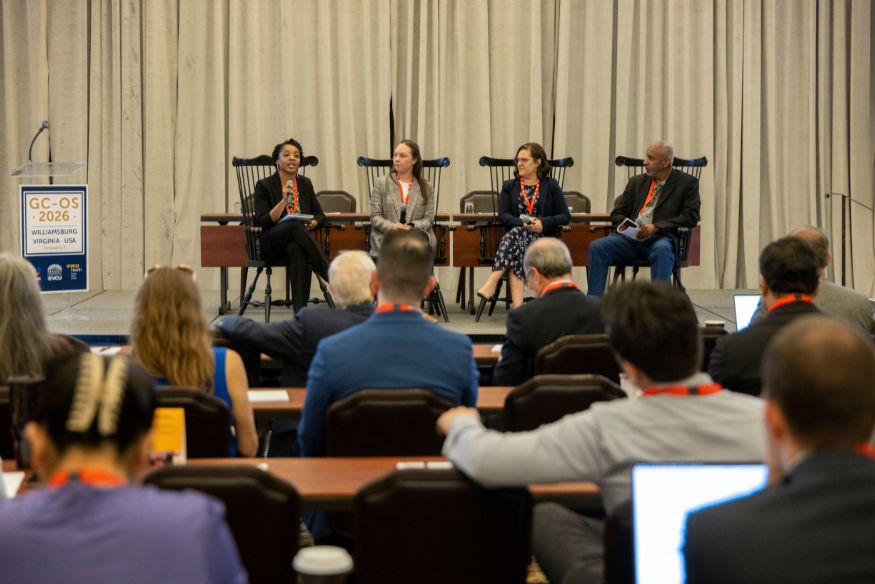
As the annual gathering of the International Cardio-Oncology Society, GC-OS brings together a global audience of cardio-oncology professionals to learn and discuss the latest practices in prevention and management of cardiovascular disease among cancer survivors.
More than 200 attendees were greeted on October 5 with opening remarks by IC-OS president Michael Fradley, M.D., medical director of the Thalheimer Center for Cardio-Oncology at the University of Pennsylvania.
“We all share the same goal. We want cancer patients to survive and live long, healthy lives without heart issues. This conference brings together a global community to help shape the future of the field in order to serve that goal,” Fradley said.
Both Monica L. Baskin, Ph.D., FSBM, cancer center director and Lipman Chair in Oncology at Massey, and Fadi N. Salloum, Ph.D., senior associate dean for research at the VCU School of Medicine, Natalie N. and John R. Congdon, Sr. Endowed Chair and Professor of Cardiology at Pauley, and member of the Cancer Prevention and Control (CPC) research program at Massey, addressed the collaboration required in cardio-oncology and how Massey and Pauley serve as worldwide models.
Baskin remarked, “We are truly partners at VCU. We have two fabulous centers in Pauley and Massey who recognize that more and more people are surviving cancer, which is great, but also comes with a greater need to address potential gaps in survivorship and how cancer treatments affect the heart.”
Salloum commented, “Addressing these challenges requires collaboration and willingness to work across traditional teams. At VCU, we are proud to host this summit in tandem with the VCU Health Pauley Heart Center and VCU Massey Comprehensive Cancer Center. The collaboration embodies the very essence of cardio-oncology. The most impactful work occurs when we work across multiple disciplines toward a shared goal.”
Concluding the opening remarks, Wendy Bottinor, M.D., MSCI, the medical director of the Cardio-Oncology Program at Massey and Pauley, implored her colleagues to use the conference to energize each other about the future of cardio-oncology.
“At GC-OS 2026, we want to go beyond the fundamentals of cardio-oncology and dive into the cutting-edge research and treatments that enable us to push the boundaries of what is possible,” Bottinor said.
Patient perspectives on the cardio-oncology journey
Appropriately, the GC-OS opened with a panel that focused on the patients who receive cardiovascular care in concert with their cancer treatments.
Moderating the panel, Arnethea Sutton, Ph.D., member of the CPC research program at Massey, remarked, “It’s easy to get stuck in our bubbles, and it’s so important to listen to those who have been treated for both cancer and cardiovascular disease. We cannot truly have impact unless we have connections with the people who receive these treatments.”
Panelists Alexandra Marshall, Tara Daudani and Russell Dove shared their cancer journeys and how the cardio-oncology programs supplemented and improved their overall cancer care.
Marshall, who was treated for a Hodgkin lymphoma when she was just 20, commented, “Just because you’ve rang the bell, doesn’t mean your cancer journey is completely over. I still felt tired, and it took years before I felt more like myself. Even 11 years out, I still need to take care of myself and my heart.”
Now a clinical research manager at Pauley in the cardio-oncology department, Marshall knows firsthand how important having quality cardio-oncology care is for a patient.
“It wasn’t until I got to VCU and worked with Dr. Bottinor and her team, and I knew that I’m in good hands and receiving the best care possible,” Marshall said. “My anxiety going into appointments is greatly reduced from where it was because I have a team that has my back.”
In her role at Pauley, Marshall worked directly with Dove, who has fought prostate cancer on and off for 16 years. His current treatment plan is known to have a negative impact on the heart, so he is monitored by the cardio-oncology team.
Even with multiple recurrences of his cancer, Dove maintains a positive outlook: “For me, despite the fact I have been dealing with this for 16 years, I want to have 16 more years with my family, with my wife of 37 years, with my children and grandchildren. Being part of Massey’s clinical trial and treatment program is helping me do that.”
Daudani echoed Marshall’s comments regarding her journey not being over.
“I didn’t see heart problems coming at all, and it took a lot to realize I would be on multiple medications for the rest of my life,” Daudani said. “It’s a constant, every day thing for me. And while the cancer part is over, this [heart] is with me the rest of my life.”
An avid tennis player and mother to two daughters, she cited Massey’s survivorship clinic as a critical factor in having her heart checked in the first place, before it became a larger issue.
“We are so fortunate to have a survivorship clinic [in Richmond], and it was Dr. [Susan] Hong who mentioned the need to check my heart. We’re really lucky that we have more survivors living longer, and that VCU Massey is building the resources to help us live our best lives possible.”
Experiences shared from around the world
Khalid Matin, M.D., a medical oncologist at Massey, participated in a panel discussion with experts from around the world in which providers and researchers discussed the challenges and opportunities that exist in cardio-oncology care. Panelists from Brazil, Japan, Australia and India expressed their country’s and region’s respective challenges and opportunities within cancer care and cardio-oncology.
Matin provided his perspective on how to expand the reach of cardio-oncology through his lens as associate director of global oncology at Massey, “One of the opportunities I saw at VCU was that we were one of a few NCORP sites among NCI-designated cancer centers, which allows us to take trials to the patients, rather than the other way around. We work locally, identifying community partners and community champions. Our partners are the ones helping us introduce clinical trials into their community and helping us, and GC-OS can use a similar model as it works to expand and increase understanding of this field.”
In discussing how to increase awareness of cardio-oncology, Matin noted, “One of the things that can be done on the global level is elevating this group and the role of cardio-oncology. As cancer survivorship continues to grow, we are going to see an increasing need for cardio-oncologists. As we’re training the next generation of doctors, making them aware of both oncology and cardiology, and how these fields can be intertwined, is important, too.”
Looking ahead: the role of AI in cardio-oncology
As with most industries, cardio-oncologists are looking at how artificial intelligence (AI) tools can improve diagnoses, treatment plans, risk management and the overall care of cancer patients, moving from more reactive care to proactive.
By taking several signals (ECG, imaging, EHR, biomarkers, wearables) and utilizing AI, a personalized cardiovascular risk could be assessed for each patient, possibly leading to better treatments and outcomes. In doing so, patients who need more intensive monitoring or prevention efforts could receive it prior to it becoming a critical need.
Panelists also discussed how to build predictive models to better assess which cancer patients might be more at risk for cancer therapy-related cardiac dysfunction within their care, based on several predictors.
Still, with all the advances in AI, providers emphasized that maintaining trust with patients, consistent workflows across the industry and continuing to build better predictive models will continue to be a key as AI tools begin to take a foothold in cardio-oncology.
Moving cardio-oncology into the future
Justin Canada, Ph.D., RCEP, a member of the CPC research program at Massey and associate professor of cardiology and senior clinical exercise physiologist at Pauley, co-chaired a panel session featuring international experts on the topic of “precision exercise.” This concept involves employing tailored physical and behavioral interventions to improve quality of life and outcomes among cancer patients and survivors.
Alexander Lucas, Ph.D., a member of the CPC research program at Massey and an assistant professor of social and behavioral sciences at the VCU School of Public Health, presented on the benefits of behavioral lifestyle programs in cardio-oncology. He emphasized the importance of an active lifestyle for patients’ overall wellbeing, while adding the need for them to be appropriately evaluated to ensure that any exercise program can be started safely for every patient based on their individual needs and health.
Raouf Gharbo, DO, director of autonomic rehabilitation at VCU Health, discussed the role of autonomic dysfunction in cancer fatigue. He mentioned that factors including sleep, breathing and recovery all affect exercise tolerance, and that his universal starting question for all patients is to determine if they have rhythmic breathing with their diaphragm muscle.
“There is a relationship between heart rate variability and the metabolic system,” Gharbo said. “I like to tell my patients to think of their body like the car in the pit stop, not in the garage.”
One size does not fit all for cardiovascular health
A group of international speakers from the U.S., Canada and Ghana participated in a joint conversation presented by the IC-OS and the Multinational Association of Supportive Care in Cancer. They commented on global perspectives in cancer survivorship and cardiovascular health; prevention and management of cardiovascular disease in adults with cancer; and practical implementations for oncology teams related to how lifestyle and exercise impact a patient’s survivorship.
“It’s not one-size-fits-all,” said Hannah Ayettey Anie, MB, ChB, senior specialist radiation oncologist at Korle Bu Teaching Hospital in Ghana, as she stressed the need to tailor health interventions based on different regions and populations worldwide. “Cardiovascular health must become a core pillar of global cancer survivorship.”
A bright future for treating amyloidosis
Keyur Shah, M.D., interim chair of cardiology at Pauley, led a panel session on the newest clinical options for the treatment of amyloidosis, a rare but increasingly diagnosed disorder characterized by the accumulation of abnormal proteins—amyloids—on internal organs. Some forms of amyloidosis are linked to certain forms of blood cancers, and Pauley is home to one of the largest cardiac amyloidosis clinics in the Mid-Atlantic. Doctors from Mayo Clinic and Memorial Sloan Kettering Cancer Center, including Morie Gertz, M.D., and Heather Landau, M.D., reviewed the rapidly changing paradigm for this difficult-to-treat disease, and the need for clinical trials to continue to advance therapeutic strategies.
“We will never get drugs approved if we can’t accrue patients to clinical trials, but the future is really bright ahead,” Landau said.
Understanding the toxicities of the latest therapies
David Chuquin, M.D., a cardio-oncologist at Massey and Pauley, co-chaired a session on the cardiovascular toxicities associated with the latest generation of cancer therapies.
During this session, Wendy Bottinor, M.D., presented on the known cardiovascular toxicities of BTK inhibitors, a class of drugs that blocks an enzyme that contributes to blood cancer growth and survival. She commented on the review of second generation inhibitors and observations of similar or reduced rates of atrial fibrillation, hypertension and cardiac death in patients being treated with these newer drugs. Bottinor highlighted the potential for future innovative combination therapies to shift the landscape for mitigating cardiac issues in cancer treatment.
Mary Helen Hackney, M.D., medical oncologist and director of community oncology at Massey, provided an overview of the toxicities associated with new breast cancer therapies, including the expanding use of antibody-drug conjugates and CDK4/6 inhibitors in treatment. Common toxicities to be aware of include hypertension, heart failure, irregular heartbeat and increased risk of thrombosis and blood clots.
Strategies for overcoming some of these long-term heart-related complications should be prioritized, Hackney said. These can include monitoring EKGs at more regular intervals, paying attention to electrolyte levels, recognizing that older patients may be more at risk for cardiac issues, among others.
“We have people living longer after early-stage cancer, so it’s important that we know what we’re doing to our patients and promote their survivorship,” Hackney said.
Unique challenges facing cancer survivors
During a panel discussion on the challenges facing patients long after they complete their final treatment, Susan Hong, M.D., director of the Cancer Survivorship Program at Massey, talked about cardiovascular monitoring in long-term survivorship. Because of the increased risk of a secondary chronic health condition following a cancer diagnosis—often years later—she said that survivors should really have a primary care physician who can offer supplementary long-term care after a cancer specialist may no longer be needed as often for routine follow-ups.
Hong said that a significant percentage of her patients do not have an established primary physician, and the survivorship team can serve as a clinical conduit, assessing long-term health and cardiovascular risks among cancer patients and helping refer them to the future supervision of a primary care provider.
Mohammed Quader, M.D., professor of cardiothoracic surgery and surgical director of the heart transplantation program at Pauley and the VCU Health Hume-Lee Transplant Center, covered how radiation treatment contributes to increased risk of coronary artery disease, heart failure and other cardiac complications.
Long-term issues such as radiation-mediated aortic valve disease often present in patients decades after their final radiation treatment, but Quader said that understanding late complications like this can inform strategies for mitigating damage at the time of initial treatment. One advanced option is called a transcatheter aortic valve replacement, which is a minimally invasive procedure that has been associated with significantly lower adverse complications in cancer patients.
“The heart is the organ that keeps every other organ alive,” Quader said. “The use of a multidisciplinary cardio-oncology and heart team approach is the most prudent pathway” for holistically treating cancer patients and reducing their risk of long-term health issues related to radiation or other therapies.
The future of cardioprotection for cancer patients
An international panel of experts gave an overview of the protective treatment options on the horizon for the heart health of cancer patients, including the impact of GLP-1 receptor agonists on cardiovascular disease, the role of statin therapies, the effects of SGLT2 inhibitors, as well as non-pharmacologic treatment options to prevent cardiotoxicity in patients.
The final day of the summit featured two separate symposiums: one geared toward basic science discoveries and the other tailored for advanced practice providers.
Photos from GC-OS 2026 are available here.
Related News
Research & Innovation
Simulating cellular environments to fight advanced prostate cancerOct 7, 2026

Get access to new, innovative care
Treatments in clinical trials may be more effective or have fewer side effects than the treatments that are currently available. With more than 200 studies for multiple types of cancers and cancer prevention, Massey supports a wide array of clinical trials.
Find a provider
Massey supports hundreds of top cancer specialists serving the needs of our patients. Massey’s medical team provides a wealth of expertise in cancer diagnosis, treatment, prevention and symptom management.