Latest News
Research & Innovation
Massey launches new seminar series with Sidney Kimmel leader, focus on pancreatic cancer
Feb 13, 2024
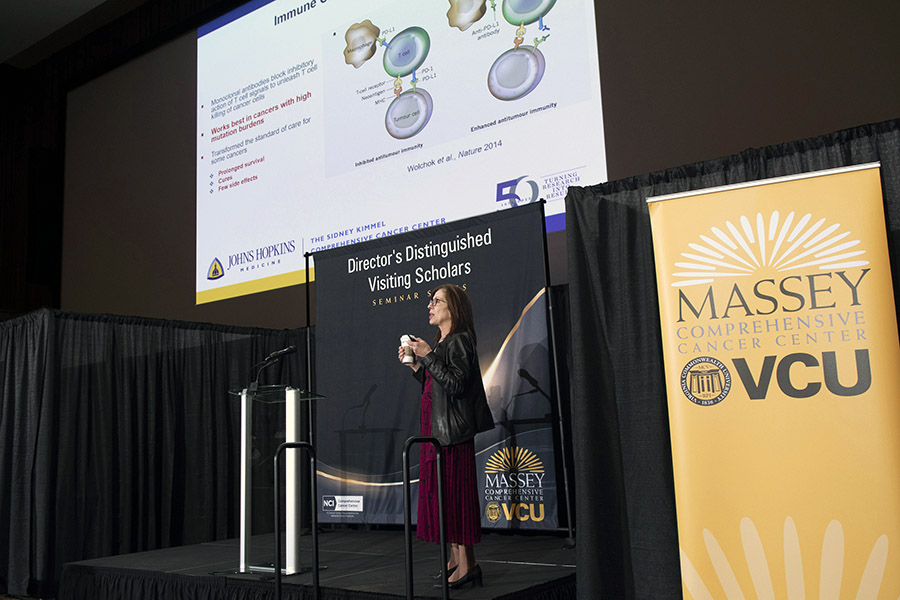 Elizabeth Jaffee, M.D., was the inaugural speaker in the Massey Director’s Distinguished Visiting Scholars Seminar Series. (Photo credit: Duane Berger)
Last week, VCU Massey Comprehensive Cancer Center held its inaugural Director’s Distinguished Visiting Scholars Seminar Series, featuring Elizabeth Jaffee, M.D., deputy director of The Sidney Kimmel Comprehensive Cancer Center at Johns Hopkins and chair of the President's Cancer Panel, which advises the U.S. president on the National Cancer Program. Her visit included three separate dialogues – with VCU scientists, clinicians, trainees, community advocates and more — on new opportunities for pancreatic cancer treatment and prevention.
Jaffee’s first stop on her two-day speaking tour was a fireside chat at the Virginia Museum of History and Culture on Thursday. In front of an intimate audience, Jaffee talked about President Biden’s Cancer Moonshot, the National Cancer Plan and how vital it is to engage in information sharing across multiple areas of oncology – from advocating for industry change before the federal government to examining cancer care to level access for a number of populations.
During the hour-long chat, Jaffee, who also is a professor of oncology, opened with a very powerful and alarming statistic about the rise of the global cancer burden, which estimates by 2040 roughly 27 million people will have a cancer diagnosis. Another startling trend she mentioned is that cancer is on the rise among younger people in their early 30s – a far cry from the recommended ages for certain cancer screenings, starting in the mid-40s.
“How do you get the message to young people?” Jaffee asked the onlookers as she talked about cancer screenings. “Colon cancer is happening in 30-year-olds and 50-year-olds.”
After posing these questions, an in-depth chat followed with attendees sharing and recommending paths to equitable cancer care. The room emanated with topics like the use of technology and artificial intelligence, increasing resources for rural populations, insurance coverage and rethinking how to offer care and services outside of traditional business hours. It was almost like “oncology therapy” for some of the providers, nurse navigators, nonprofit cancer advocacy representatives and survivors who came to hear Jaffee speak.
As the fireside chat came to a close, Jaffee encouraged the group to keep sharing ideas with her: “I want to learn from everybody. It’s helping me to do a better job.”
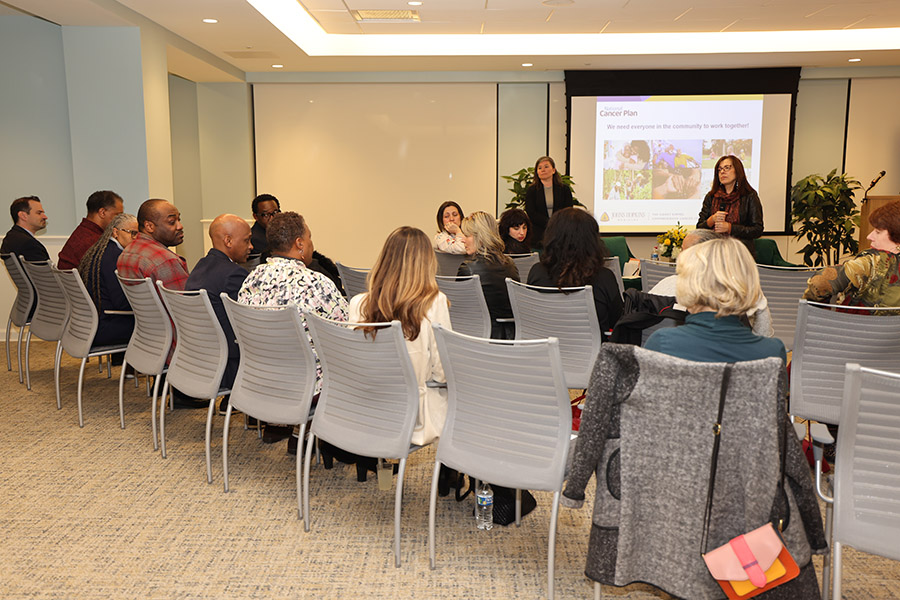 Elizabeth Jaffee, M.D., participated in a fireside chat at the Virginia Museum of History and Culture on Thursday.
On Friday morning, Jaffee — the first woman in her family to attend college — led a conversation with dozens of students and trainees from VCU regarding her academic path to a career in oncology and some key advice for the future generations leading cancer science. She said that the field of cancer was always something that interested her, but it wasn’t until she was directly faced with an opportunity to pursue research in pancreatic cancer — coupled with the fact that her uncle also died of the disease — that she discovered the next step that would shape her career.
“Doors open for you all the time,” Jaffee told the crowd of future scientists and clinicians, adding that the smartest scientists are those who investigate why something didn’t work previously in an attempt to identify novel solutions.
Jaffee also explained how drastically technology has advanced since she first started in her career, and how exciting it will be for emerging cancer researchers to use that continued evolution to their advantage.
“Think about all the amazing things that are going to happen in the next 10-20 years, and you all are going to be a part of it,” Jaffee said.
Anna Kovilakath, Ph.D., a postdoctoral student at Massey, said the discussion gave her key insights into how broad applications of her own science can help set the stage for her career. Additionally, she found the more casual setting of this seminar helped break down certain barriers that can sometimes exist between academic leaders and students.
“I think it can be really intimidating to meet someone like Dr. Jaffee because she is so accomplished in many ways,” Kovilakath said. “Setting up something that is a little more informal can really let you ask the questions that are going to be helpful for you as well as your colleagues.”
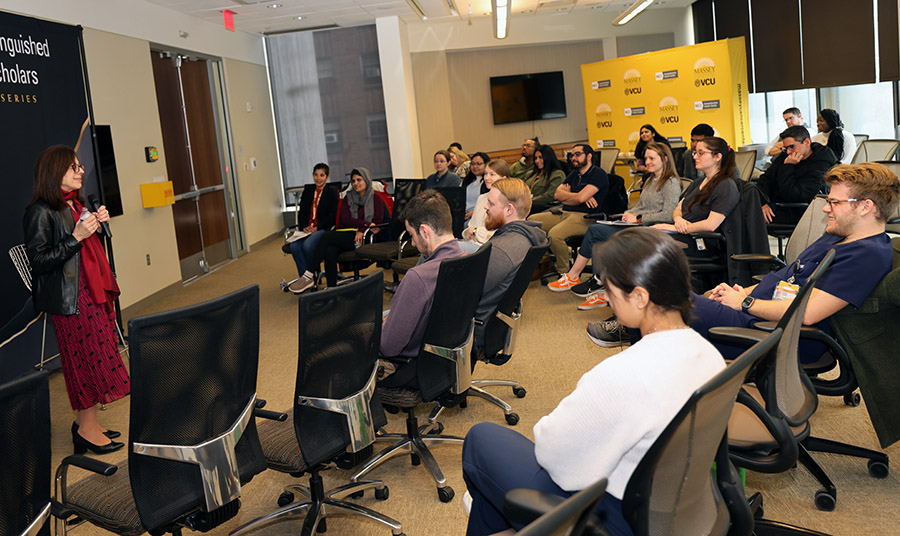 Elizabeth Jaffee, M.D., led a conversation with dozens of students and trainees from VCU regarding her academic path to a career in oncology and some key advice for the future generations leading cancer science.
On Friday afternoon, Jaffee presented a talk, “New Opportunities for Treatment and Prevention of Pancreatic Cancer," to more than 200 VCU faculty and staff members. During the seminar, Jaffee discussed her career work in developing novel genetically modified pancreatic tumor vaccines and how her hypotheses have orbited the topic of effective immunotherapy treatment options for pancreatic cancer.
“We have made progress, but pancreatic cancer will still be the second cause of cancer death by 2030,” Jaffee noted, explaining that her decades-long work investigating vaccines has led to high-impact findings that a novel vaccine was associated with longer-term survival in patients with pancreatic tumors.
Jaffee also discussed the concept of integrating large biological data sets and using computational tools to help predict immune response to new drugs. She added that now is the right time to study cancer vaccines and target specific oncogenes.
“We have better drugs and know we have disparities, but we have to look at better preventions,” Jaffee said. “The global burden of cancer is increasing. This is unbelievable…We need to really think about better preventions.”
In her research, Jaffee found vaccines given before cancers become invasive seems to be the most effective method, where the timing of vaccination is critical as pre-cancerous environment evolves. Her lab is currently conducting a trial investigating a peptide vaccine that targets KRAS mutations in pancreatic cancers, administered prior to surgical resection.
Jaffee told the audience that she hopes to collaborate with Massey in the future and thanked the cancer center for hosting her.
“I’ve had the two most amazing days,” Jaffee said. “What I’m going to take home is that there’s so much passion and innovation and excitement at this place. This place has more than I’ve seen in a long time.”
Massey’s new quarterly series will feature national and international visionaries in the field of science, and during each visit, high-profile speakers will engage in lively discussions on how the latest science advances are influencing new strategic approaches in cancer prevention, diagnosis, treatment and survivorship. The next seminar in the series is scheduled for June 2024.
Written by: Vanessa Copeland, Blake Belden and Amy Lacey
Related News
Research & Innovation, Clinical Care, Prevention , Leadership
International community gathers for 2026 Global Cardio-Oncology Summit in WilliamsburgOct 14, 2026
Research & Innovation
Simulating cellular environments to fight advanced prostate cancerOct 7, 2026

Get access to new, innovative care
Treatments in clinical trials may be more effective or have fewer side effects than the treatments that are currently available. With more than 200 studies for multiple types of cancers and cancer prevention, Massey supports a wide array of clinical trials.

Find a provider
Massey supports hundreds of top cancer specialists serving the needs of our patients. Massey’s medical team provides a wealth of expertise in cancer diagnosis, treatment, prevention and symptom management.